Piquet Card Game Rules
Piquet is a card game for 2 players. A game typically takes 30-60 minutes, and the recommended age is 12+.
Rules for the card game Piquet: A classic for two with 32 cards. Trade with the talon, declare point, sequence and set, then take the tricks. Piquet is also known as Rubicon Piquet, Sant or Saunt.
About the Game
Piquet is a game for two, played with a short pack of 32 cards over six deals. Whoever has the higher total when the sixth deal is finished wins the partie. It is one of the oldest card games still in regular play.
Every deal runs through the same four stages. You swap cards with the talon, declare the combinations in your hand, play out twelve tricks, and settle up. Scoring happens all the way through rather than at the end, and tradition has you call your total out loud every time it changes.
Expect to spend an evening before the scoring feels natural. What you get in return is a game where, by the last few tricks, you know almost exactly what your opponent holds, so the play becomes arithmetic rather than guesswork. French sources mention the game as early as 1535 under the name Cent, and the name Piquet turns up in 1585.
What You Need
- A deck with the jokers and everything from 2 to 6 taken out, leaving 32 cards
- Two players
- Pen and paper
The short pack is called a piquet pack, and building one takes half a minute. Strip out the jokers and the 2s through 6s, and each suit is left with 7, 8, 9, 10, Jack, Queen, King and Ace.
Write the totals down after each deal. During a deal you keep the running score in your head and say it out loud, so both players always know where things stand. Six deals take somewhere between 30 minutes and an hour.
Card Ranking
All four suits rank the same way, from the top: Ace, King, Queen, Jack, 10, 9, 8, 7.
Piquet has no trump suit at all. A trick always goes to the highest card of the suit that was led.
Cards also carry a face value, and it is used in exactly one situation: when both players hold the same number of cards in their longest suit and the point has to be settled. An ace counts 11, court cards 10 each, and the rest their own number. So ♠️A ♠️K ♠️Q ♠️J ♠️10 is worth 51, while ♣️K ♣️Q ♣️J ♣️10 ♣️9 comes to 49.
The Deal and the Talon
Cut for a card before the first deal. Whoever draws higher decides who deals first, and should pick themselves.
The dealer gives twelve cards to each player, in twos or in threes. Say which before the first deal and stick to it for the whole partie. The eight cards left over go face down in the middle as the talon, spread into two separate piles of five and three.
The dealer is called younger hand. The opponent is elder hand and has the advantage in the deal, because elder hand swaps the most cards, declares first and leads to the first trick. The deal alternates, so each player gets three deals as elder hand.
That is why you want to deal first. Take deals 1, 3 and 5 as dealer, and you are elder hand on deals 2, 4 and 6. The sixth deal is the one that settles the partie, and you want the advantage there.
Carte Blanche
A hand without a single court card, meaning no Jack, Queen or King, is a carte blanche and scores 10 points. It comes up rarely, and it is the only score handed out before the exchange.
Say so the moment you spot it, then prove it by laying your cards face up on the table quickly. Elder hand shows straight away. Younger hand announces straight away but holds the cards back until elder hand has finished exchanging, otherwise elder hand would know the whole hand before choosing what to throw.
Carte blanche counts before everything else when a repique has to be worked out.
The Exchange
Both players now trade cards with the talon, elder hand first.
- Elder hand puts at least one and at most five cards face down, then draws the same number off the pile of five. Passing is not an option, at least one card has to go.
- Younger hand follows, again with at least one card and at most however many are left in the talon. If elder hand took all five, three remain.
- Taking fewer than you are allowed is fine, but say so before you draw.
Cards you leave behind are not lost to you, though the two players see them differently. Elder hand who swaps three may look at the other two privately. Younger hand who leaves cards may turn them face up for both players once elder hand has led to the first trick.
Keep your discards beside you on the table. You are allowed to check them at any point in the deal, and it pays to do it, because forgetting what you threw is easy.
Elder hand nearly always takes all five in practice. Five fresh cards beat hanging on to a stray ace, and every card you leave is one more for younger hand to pick from.
Declarations: Point, Sequence and Set
With the exchange done, both players declare what they hold. There are three categories, and they always come in this order.
Point is your longest suit. Holding five spades and fewer of everything else, you announce "point of five". Whoever wins the category scores one per card, so 5 here.
Sequence is three or more cards of one suit in ranking order. The names are French, and the scoring takes a sharp jump between four cards and five:
| Sequence | Cards | Points |
|---|---|---|
| Tierce | 3 | 3 |
| Quart | 4 | 4 |
| Quint | 5 | 15 |
| Sixième | 6 | 16 |
| Septième | 7 | 17 |
| Huitième | 8 | 18 |
Set is three or four cards of the same rank, but only tens and above. Three of a kind is a trio and scores 3, four of a kind is a quatorze and scores 14. Three or four nines, eights or sevens are worth nothing whatsoever.
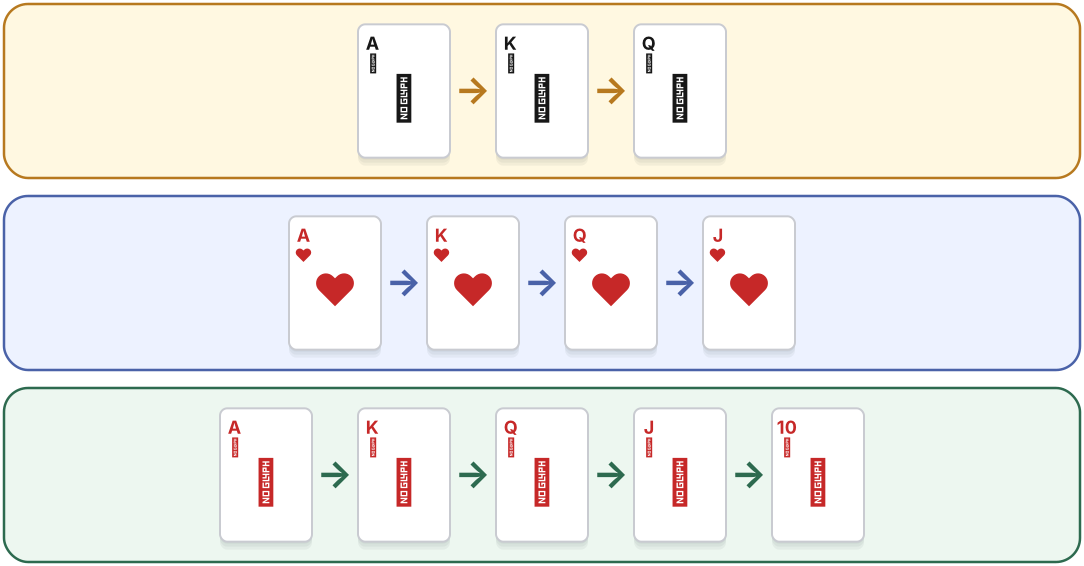
How Declaring Works
Elder hand declares first in each category, and younger hand answers with one of three words.
- "Good" means elder hand has the better one and may score it.
- "Not good" means younger hand has something better, and younger hand scores the category instead.
- "Equal" means they are the same length. Elder hand then has to say more: the face value for the point, the top card for a sequence. Still equal, and neither player scores.
A category goes to one player entirely. Whoever holds the best sequence also scores every other sequence in their hand, and the opponent takes nothing for sequences no matter what is sitting there. Sets work the same way.
Say you hold a quint in spades and a tierce in hearts, while your opponent holds a quart in diamonds and a tierce in clubs. Your quint is longest, so you score 15 for it and 3 for the tierce, 18 in all. Your opponent scores nothing, even though the quart on its own was worth 4.
Sequences of equal length are settled by the top card, so ♠️A ♠️K ♠️Q beats ♥️K ♥️Q ♥️J. Any quatorze beats any trio, and between two of the same size the higher rank wins, so four aces beat four kings. Two sets can never be identical, so sets never end level.
Nothing forces you to declare. Holding a combination back is called sinking it. You give up the points, but your opponent learns less about what you have kept for the tricks.
Repique and Pique
Two bonuses come into play when one player sweeps the declarations and the other scores nothing at all.
Repique is worth 60 extra points. You earn it by reaching 30 points on declarations alone before your opponent has scored anything on declarations.
Pique is worth 30 extra points. You earn it by reaching 30 on declarations and play combined before your opponent has scored anything. Only elder hand can ever manage it, since elder hand has banked at least the point for the opening lead by the time younger hand enters any score at all.
Whether a bonus applies is decided by a fixed order of reckoning:
- Carte blanche
- Point
- Sequences
- Quatorzes and trios
- Points made in play
Suppose younger hand holds ♠️K ♠️Q ♠️J ♠️10 ♠️9 and ♥️K ♥️Q ♥️J ♥️10 ♥️9, which is a point of five for 5 and two quints for 15 each. Elder hand holds four aces, a quatorze worth 14, but no suit longer than four cards. Younger hand takes both the point and the sequences and stands at 35 by the time sets are reckoned. Sets come last, so elder hand has still scored nothing and younger hand collects the repique. The declarations were worth 95 instead of 35.
The same order can take the bonus away from you. Score 30 on sequences and sets while your opponent holds the better point, and there is no repique, because the point is reckoned before the sequences and your opponent got there first.
A tie in a category does not count as the opponent scoring, so it never blocks either bonus. You cannot collect both in one deal either: a repique rules out a pique. And the 10 for the cards and the 40 for capot never count towards a pique, however early they are locked up.
Playing the Tricks
Elder hand leads to the first trick. Follow suit when you can, and throw whatever you like when the suit is gone from your hand. The highest card of the suit led takes the trick, and the winner leads to the next one. Either player may look through the tricks already played at any time.
The scores here are small and frequent:
- 1 point every time you lead a card
- 1 point when you take a trick your opponent led to
- 1 extra point for the last trick
Note that taking a trick you led to yourself pays nothing further. You already had the point for the lead.
There is a shorter way of counting that comes to exactly the same total. Elder hand starts on 1 for the opening lead. After that, every trick you win is worth 1 point if you led to it and 2 if your opponent did. Stack the one-point tricks face down in front of you and the two-point tricks face up, then count at the end instead of doing sums during play. Counted this way, the last trick needs no separate bonus, since it is already covered.
The tricks themselves are worth a bonus once play is over:
- Taking the majority, meaning seven or more, is worth 10 points for the cards
- Six tricks each and neither player gets anything
- Taking all twelve is capot, worth 40 points instead of the 10
Scoring, the Partie and the Rubicon
A match is called a partie and runs to exactly six deals. Write down both totals after each deal and add them to the running score. Whoever leads after the sixth deal wins.
Then comes the Rubicon, which is what gives the loser something to play for. The losing player has to reach at least 100 points across the partie to have crossed it.
- Loser on 100 or more: the winner scores 100 plus the difference between the two totals.
- Loser under 100: the winner scores 100 plus the sum of both totals.
Take a partie ending 154 to 113. The loser is over the line, so the winner scores the difference of 41 plus 100, which is 141. Now let the same partie end 154 to 93 instead. The Rubicon is not crossed, so the winner scores 154 plus 93 plus 100, which is 347. Twenty points fewer for the loser more than doubles the bill.
If the scores are level after six deals, play two more. Should those leave the totals equal as well, the partie is drawn.
The Rubicon changes how the sixth deal is played. Sitting under 100 with the partie already lost, you play to get over the line. Sitting in front, you play to keep your opponent short. Every change of lead during the tricks puts another point on the table, so a player chasing 100 is happy to see the lead bounce back and forth.
A Deal from Start to Finish
Here is a full deal seen from elder hand. After the exchange you hold ♠️A ♠️K ♠️Q ♠️J, ♥️A ♥️K ♥️Q, ♦️A ♦️10 ♦️9 and ♣️A ♣️7. Younger hand holds ♠️9, ♥️J ♥️10 ♥️9, ♦️K ♦️Q ♦️J and ♣️K ♣️Q ♣️J ♣️10 ♣️9.
You declare a point of four. Younger hand has five clubs, says "not good", and scores 5.
Sequences come next. Your quart ♠️A ♠️K ♠️Q ♠️J runs straight into the quint ♣️K ♣️Q ♣️J ♣️10 ♣️9, so the answer is "not good" and the whole category goes across the table: 15 for the quint, 3 for the tierce in diamonds and 3 for the tierce in hearts, 21 altogether. Your quart and your heart tierce count for nothing.
The sets come last. You declare four aces, three jacks are not enough against a quatorze, and younger hand says "good", so 14 points are yours. The declarations leave it 14 to 26.
You lead ♠️A and say 15. Younger hand follows with a lone spade. Your three remaining spades run as well, taking you to 18, and then three heart tricks and one with ♦️A bring you to 22.
On the ninth trick you lead ♦️10 and say 23. Younger hand takes it with ♦️K and says 27, then leads ♣️K for 28, and you win it with ♣️A for 24. You lead ♦️9 and take it, 25, then ♣️7, 26. Younger hand takes that last trick with ♣️J and collects both the trick and the point for the last trick, reaching 30.
Ten tricks to two means the 10 for the cards is yours, and the deal finishes 36 to 30. You won it, but the 21 younger hand picked up for sequences alone will show in the partie total.
About this version
These rules cover Rubicon Piquet, the version that has been standard in English-speaking countries since the late nineteenth century and that the Portland Club laws set out. The pack is 32 cards, a partie is exactly six deals, and the loser needs 100 points to cross the Rubicon. Older forms such as Piquet au Cent score differently and are listed under variants.
Do you play with different rules where you live, or did you spot a mistake? Send me an email.
Similar games
Klaberjass (alias Clobyosh, Klabberjass, Klob, Kalabrias or Bela)
A game for two with 32 cards. Name trumps, score for runs and bela, and lose it all if you fail.
500 Rummy (alias 500, Rummy 500, 500 Rum or Pinochle Rummy)
Lay down groups and sequences, dig into the discard pile for the card you need, and pass 500 points first.
Remi (alias Liverpool Rummy or Contract Rummy)
Seven rounds, each with its own contract of sets and runs. Buy the cards others throw away and keep your score low.