Five Hundred Card Game Rules
Five Hundred is a card game for 3-6 players. A game typically takes 45-75 minutes, and the recommended age is 10+.
Rules for the card game Five Hundred: Bid your tricks and trumps, swap with the kitty and play ten tricks. The joker is the top trump. Five Hundred is also known as Fem hundre.
This page covers the trick-taking game Five Hundred. The rummy game that shares the number has its own page under 500 Rummy.
About the game
Five Hundred is a bidding trick game. You announce how many tricks your side will win and which suit is trumps, and then you have to deliver. Four players in two fixed partnerships, partners facing each other, is the standard game, and a match runs until somebody passes 500 points.
It was invented in the United States around 1900 and sold by the US Playing Card Company, deck and rulebook together, in 1904. Australia adopted it wholesale and it is the national card game there. The auction has a family resemblance to bridge, but you can learn the whole thing in a quarter of an hour.
A hand comes in three parts: the auction, the exchange with the kitty, and ten tricks. Three features set it apart from the euchre it grew out of: the joker outranks every trump, the jacks beat the aces in the trump suit, and whoever wins the auction swaps three cards with the kitty.
What you need
A 43-card pack, which you build from an ordinary deck: remove every 2 and 3 and the two black 4s, then add one joker.
Hearts and diamonds then run from ace down to the 4, while spades and clubs stop at the 5. Some packs pull ♠️4 and ♦️4 instead, which works just as well as long as you end up with 43 cards and 13 trumps in whichever suit is named.
The joker is often called the bird, because Australian Five Hundred packs show a laughing kookaburra where other decks put a jester. Pen and paper are essential too, since scores move in large jumps and can drop below zero.
Card ranking
In the suits that are not trumps, ranking is ordinary: ace high, then king, queen, jack, 10 and down.
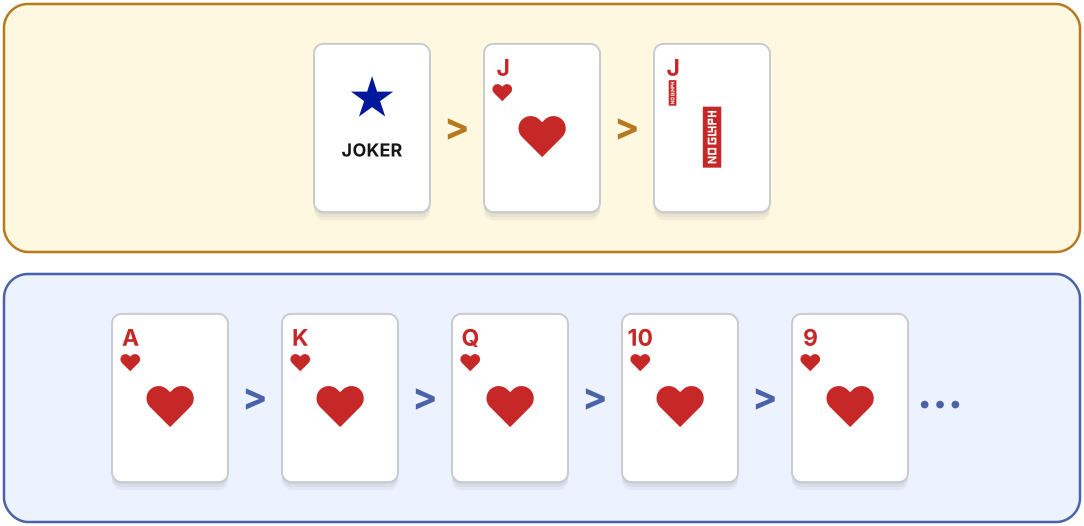
Trumps rearrange the jacks. The joker sits on top, then the jack of the trump suit, called the right bower, then the other jack of the same colour, called the left bower. That borrowed jack counts as a trump for the whole hand.
With ♥️ as trumps the order runs joker, ♥️J, ♦️J, ♥️A, ♥️K, ♥️Q, ♥️10, ♥️9 and on down to ♥️4. Diamonds are left without a jack and run ace, king, queen, 10 and downwards.
Under a no trump contract, called a grand, all four suits rank normally and the joker follows rules of its own.
Dealing and the kitty
Pick a first dealer at random and pass the deal clockwise. Everyone gets ten cards and three go face down in the middle, which is the kitty. Older books call it the widow or the blind.
Deal in batches: three each, one to the kitty, four each, one to the kitty, three each, one to the kitty. All 43 cards are then out.
Nobody touches the kitty until the auction is over. The winning bidder picks up all three without showing them and puts any three cards back face down. Those three may well be cards that just came out of the kitty.
The auction
The player to the dealer's left speaks first and bidding goes clockwise. You bid or pass, and once you have passed you are out of the auction.
- A number of tricks and a trump suit, minimum six. "Eight diamonds" undertakes that you and your partner will win at least eight tricks with diamonds as trumps.
- A number of tricks in a grand, meaning no trump suit, minimum six.
- Misère, a promise to lose all ten tricks, played alone while your partner puts their cards down.
- Open misère, the same promise, except that your hand goes face up on the table after the first trick.
Each bid must beat the last. More tricks always wins. At the same number of tricks the suits rank from the bottom up: spades, clubs, diamonds, hearts, and a grand beats them all. The cheapest possible bid is six spades and the dearest is ten grand.
Misère slots in above every seven bid and below every eight bid, and it is legal only once somebody has bid seven. Open misère sits between ten diamonds and ten hearts in value, but it may be called at any point, even as the opening bid.
If all four players pass, the hand is thrown in and the next player deals.
The bid table
Every bid is worth a fixed number of points, following the Avondale schedule of 1906.
| Tricks | ♠️ | ♣️ | ♦️ | ♥️ | Grand |
| 6 | 40 | 60 | 80 | 100 | 120 |
| 7 | 140 | 160 | 180 | 200 | 220 |
| 8 | 240 | 260 | 280 | 300 | 320 |
| 9 | 340 | 360 | 380 | 400 | 420 |
| 10 | 440 | 460 | 480 | 500 | 520 |
Misère pays 250 and open misère 500. Ten hearts is worth exactly 500, so one bid brought home can settle the whole game.
Playing the tricks
The bidder swaps with the kitty and leads the first trick. Follow the suit led if you hold it. With none of that suit you may play anything, trumps included.
A trick goes to the highest trump in it, or to the highest card of the suit led if nobody trumped. Whoever wins leads to the next one, and you carry on until all ten tricks are gone.
Remember that the joker and the left bower belong to trumps. With ♥️ as trumps and ♦️A led, you cannot play ♦️J as a diamond. It is a trump now, and it only comes out when you are void in diamonds or when you are the one leading.
In a misère contract the bidder's partner lays their cards down and sits the hand out. In open misère the bidder turns their hand face up after the first trick and plays the rest in the open.
The joker in a grand or misère
With no trump suit the joker needs rules of its own, since it belongs nowhere. A bidder holding it may assign it to a suit, but must say so before the opening lead. It then counts as the highest card of that suit.
If the bidder says nothing, or somebody else holds the joker, it belongs to no suit. It becomes the highest card in the pack and always wins its trick, but you cannot play it freely.
- When somebody else has led, you may only play the joker if you are void in the suit led.
- In misère you must play the joker when you are void. In a grand you may keep it back and discard something else instead.
- You may lead the joker and name a suit the others must follow, provided that suit has not been led before.
- Once all four suits have been led, leading the joker is illegal except to the last trick.
Bid misère while holding the joker and forget to assign it a suit, and your contract fails automatically. The joker wins whatever trick you play it to, and a won trick breaks the promise.
Scoring
Take at least the number of tricks you bid and your side scores the value from the table. The opponents score 10 points for every trick they win, whatever happens to the contract.
Tricks beyond the bid earn nothing, with one exception: winning all ten is a slam, worth 250 if the bid itself was worth less.
A failed contract costs its full value. Bid eight hearts, take seven tricks, and 300 points come off your score while the opponents write down 30 for their three tricks.
Misère pays 250 or 500 for losing every trick, and the same amount against you for winning a single one. The opponents take nothing from those points.
Winning the game
A side wins by reaching 500 or more through a contract they made themselves. Drifting past 500 on the 10-point trick scores the opponents hand out settles nothing, and the game carries on until somebody wins on their own bid.
There is a second exit. A side that sinks to minus 500 or worse loses on the spot. Australians call it going out backwards, or out the back door.
So both sides chase 500 from the front, while a partnership that has overbid twice has a hole behind them.
Other numbers of players
Everybody always gets ten cards and the kitty is always three, so the pack changes size with the number of players. With three or five there are no fixed partnerships and each player keeps a separate score.
Three players use 33 cards, ace down to 7 in each suit plus the joker. The winning bidder plays alone and the other two form a partnership for that hand only.
Five players use a full 52-card pack plus the joker. The bidder chooses between playing alone against four and calling a partner: after swapping with the kitty, name a specific card, and whoever holds it is your partner. They say nothing, so the others only work it out when the card appears. The joker and the two trump jacks cannot be called. Partners split the contract value, win or lose. Misère is always played alone.
Six players form two partnerships of three sitting alternately, using a special 63-card pack with 11s and 12s in every suit and 13s in the red ones. Play follows the four-player rules.
About this version
These rules describe four-handed Five Hundred in two fixed partnerships as played in Australia: a 43-card pack, the joker as highest trump, a three-card kitty, bids from six spades to ten grand, and the Avondale scoring schedule of 1906. Play runs to 500 points, and minus 500 loses. The three, five and six-player versions and the Norwegian scoring table have sections of their own.
Do you play with different rules where you live, or did you spot a mistake? Send me an email.
Similar games
1000 (alias Thousand, Tysiąc or Тысяча)
Trick-taking game where you bid points and use marriages strategically. First to 1000 wins.
Oh Hell (alias Oh Pshaw, Rikiki, Elevator, Blackout, Contract Whist, Up and Down the River or Blob)
Trick-taking game where you bid exactly how many tricks to take. The catch is that someone always falls short.
Belote (alias Belotte or Coinche)
France's national card game. Strategic team play with tricks and combinations for 4 players.