Casino Card Game Rules
Casino is a card game for 2-4 players. A game typically takes 25-45 minutes, and the recommended age is 10+.
Rules for the card game Casino: Fish cards off the table, set up builds you can collect later and chase the ten of diamonds and the aces. Casino is also known as Cassino, Kasino or Nordic Casino.
This page covers the Nordic version of the classic fishing card game Casino, also spelled Cassino, not gambling games played in casinos.
About the game
Casino is a fishing game for 2-4 players. The table is a pond of face-up cards, and you fish them out by playing cards from your hand that match what is lying there. Two players make the sharpest game, and four can play as two partnerships sitting across from each other.
You are after the scoring cards. The ♦️10 and the ♠️2 carry most of the weight, every ace counts, and there are points for finishing with the most cards and the most spades. The first player to 16 points wins the game.
The earliest rules appeared in England in 1792, spelled Cassino. An Italian origin is often claimed for it, but no trace of the game has been found there. The Nordic countries developed their own form of it, with builds, doubles and separate capture values for the three scoring cards, and that is the form described here.
What you need
An ordinary 52-card deck with the jokers removed, plus paper and a pencil. A full game goes over several rounds, so the score needs writing down.
Leave enough room on the table. The cards in the middle stay face up and spread out where everyone can see them. Whatever you capture goes into your own pile, face down, in front of you. Nobody touches those piles until the round is over and it is time to count.
Capture values
Three cards in the deck have two capture values: one for sitting on the table, and a higher one for being played out of your hand. Everything else keeps a single value wherever it is.
| Card | On the table | In hand |
| ♦️10, Big Casino | 10 | 16 |
| ♠️2, Little Casino | 2 | 15 |
| Ace | 1 | 14 |
| King | 13 | 13 |
| Queen | 12 | 12 |
| Jack | 11 | 11 |
| 2 to 10 | Face value | Face value |
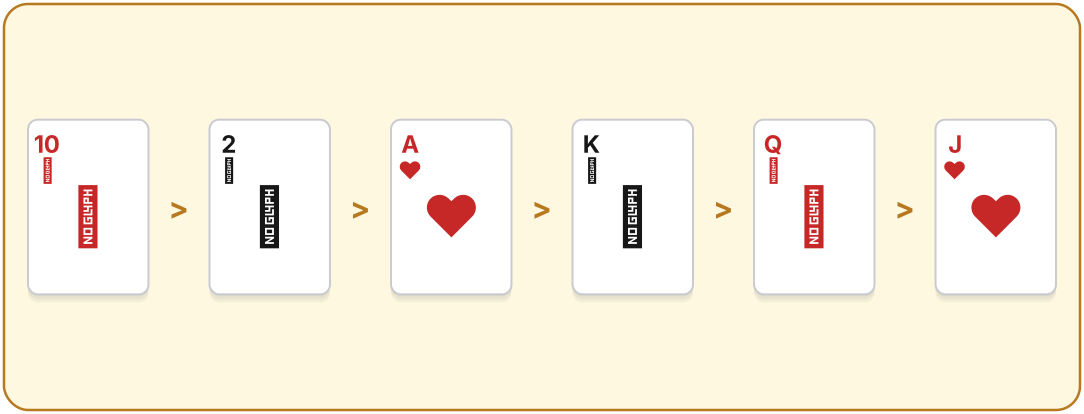
New players usually trip over the consequence. Played from your hand, the ♦️10 counts as 16, so it will not pick up a plain 10 lying on the table. The ♠️2 counts as 15 and takes no two, and an ace counts as 14, which means an ace cannot capture another ace.
What they lose in flexibility they gain in reach. With a king and an ace on the table, an ace from your hand takes both of them, since 13 + 1 = 14.
Dealing
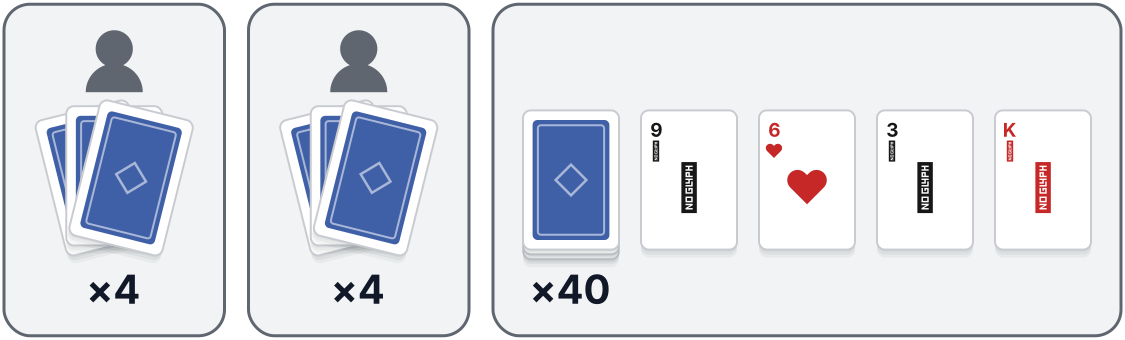
The dealer hands out two cards at a time: two to each opponent, two face up to the table, then two to themselves. Repeat that once, and everybody holds four cards with four more face up in the middle. The rest of the deck is set aside.
Once all hands are empty, the same dealer gives out four fresh cards each, still two at a time. No further cards ever go to the table after that first deal. This carries on until the deck is used up, and it always works out evenly: six deals with two players, four with three, three with four.
The dealer must say "last" when handing out the final cards, so everyone knows the round is closing. Play opens with the player on the dealer's left and moves clockwise. The next round is dealt by the player to the previous dealer's left.
Taking your turn
A turn is one card from your hand, and that card has to do one of four jobs. Passing is not allowed.
- Capture: take one or more cards off the table with the card you play
- Build: stack your card on a table card to make a total for a later turn
- Double: cover a table card with one of exactly the same value
- Trail: leave your card face up in the middle and take nothing
A card captures any table card of the same capture value, and any group of table cards whose values add up to it. You may do both at once. With 9, 6, 3, 5 and 4 on the table, a 9 from your hand collects the 9, the 6 and 3, and the 5 and 4, taking all five cards in one go.
Capturing is never compulsory. Take everything you can, take part of it, or take nothing at all. Your captures go face down in your pile together with the card you played. If the table happens to be empty on your turn, trailing is your only option.
Builds and doubles
A build is a capture you set up in advance. Lay a card from your hand half over a table card so that both stay visible, and say the total out loud. Put a 5 on a 4 and announce "building 9", and those two cards are now a single 9 that only a card capturing 9 can lift.
Two limits keep builds honest. The card that collects the build has to be in your hand at the moment you make it, and you may only have one build going at a time. Adding further cards to your own build is not allowed either.
Your opponents may extend it, though. Anyone who lays one more card on your build takes it over, and the total changes to the new sum. Your build of 9 becomes a build of 12 the moment somebody drops a 3 on it, and from then on they need the 12 to collect it. The longer a build sits there, the better the odds that somebody else walks off with it.
Doubling works differently. You place a card from your hand squarely on a table card of exactly the same value, so only your card shows. The value does not change, but whoever eventually takes the pile gets one more card out of it. Builds can be doubled the same way: holding two queens with a build of 12 on the table, drop one queen on it and keep the other to collect the lot.
Sweeps and the last capture
Clear every card off the table in one play and you have made a sweep, worth an extra point. The next player is left with a bare table and has to trail. Turn one of the captured cards face up in your pile so the sweeps can be counted later.
The round ends when the deck is gone and every hand is empty. Whoever made the last capture picks up whatever is still lying on the table and scores one point for it.
That point is not a sweep. If the card you played genuinely took the whole table, you score both and collect two points. Take only part of it and inherit the rest because the round ran out, and the last capture is all you score.
Scoring
Turn the piles over and add up. Every round holds ten points, and each sweep adds one more on top.
| Scores | Points |
| ♦️10, Big Casino | 2 |
| ♠️2, Little Casino | 1 |
| Each ace | 1 |
| Most spades | 1 |
| Most cards | 1 |
| Last capture | 1 |
| Each sweep | 1 |
When two players tie for most spades or most cards, neither of them scores it. Partners pool their piles before counting in the four-player game.
Note the totals, pass the deal along and start again. The game belongs to whoever reaches 16 points first. If two players cross 16 in the same round, the higher score wins, and if that is level too, the most spades decides it.
About this version
These rules describe the Nordic form of Casino as it is played in Norway: numbered court cards, separate capture values for the ♦️10, ♠️2 and aces, builds and doubles, and points for sweeps and the last capture. The target score is 16. The Anglo-American version without doubling is covered under variants.
Do you play with different rules where you live, or did you spot a mistake? Send me an email.
Similar games
Krypkasino
Casino in reverse, where captured cards count against you. You must capture when you can.
Go Fish (alias Fish)
Family card game for 2-5 players. Collect four of a kind and win the most books. Suitable for children aged 6 and up.
War (alias Bataille, Guerra or Battle)
Flip cards, highest wins. When cards match, it triggers a war for all the cards on the table. Simple enough for all ages.