Classic Whist Card Game Rules
Classic Whist is a card game for 4 players. A game typically takes 30-60 minutes, and the recommended age is 10+.
Rules for the card game Classic Whist: the original English trick game with trumps for four players in partnerships. The forerunner of Bridge.
This page covers the original English Whist with trumps, the forerunner of Bridge. The Norwegian game without trumps, where you bid grand or pass, has its own page: Norwegian Whist.
About the Game
Classic Whist is the original English trick-taking game and the direct forerunner of Bridge. Four players form two fixed partnerships, there is a trump suit, and there is no bidding: everything comes down to winning tricks with your partner.
The game grew up in England in the 1700s, and the name comes from an old word for quiet, since players were expected to keep still and concentrate. Around 1900 Bridge took its place, but the game survives, not least at the British social tournaments called whist drives.
The goal is to win as many tricks as you can. Every trick beyond six scores a point, and the first team to reach the agreed target wins. A game to 5 points normally takes 30-60 minutes.
What You Need
A standard 52-card deck without jokers, pen and paper for the score, and four players in two fixed partnerships.
Tradition calls for two decks. While one is being dealt, the dealer's partner shuffles the other, and the next hand is ready sooner. At home a single deck does the job.
Card Ranking
The cards rank the same in every suit, ace high: ace, king, queen, jack, 10, 9, 8, 7, 6, 5, 4, 3, 2.
On top of that sits the trump suit. Any trump beats any card of the other three suits, whatever its rank. Among themselves the trumps rank the usual way.
The Deal and Setup
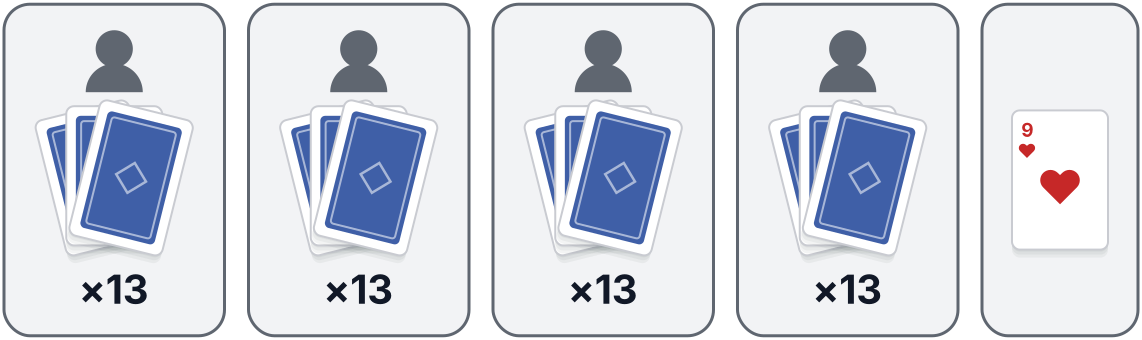
Partners sit opposite each other. The dealer shuffles, the player to the right cuts, and the whole pack is dealt out one card at a time, clockwise, until everyone holds 13 cards.
The very last card, which belongs to the dealer, is placed face up on the table. Its suit is the trump suit for the hand. The card stays face up until it is the dealer's turn to play to the first trick, when the dealer picks it up.
After each hand the deal passes clockwise.
Trumps
Trumps let a low card beat the highest cards of the other suits.
- If you have no cards in the suit that was led, you may play a trump instead.
- A trump beats every card of the other suits, whatever its rank.
- When several trumps land in one trick, the highest of them wins.
- You may also decline to trump and throw off a card from another suit. Then you cannot win the trick.
Since the last card dealt decides, the trump suit changes from hand to hand.

Playing the Game
The player to the dealer's left leads to the first trick and may play any card.
- The leader plays a card to the table.
- The other players each add one card, clockwise.
- You must follow suit if you can. Holding a card of the suit led means you have to play one.
- With nothing in the suit led, you either trump or throw off any card.
- The highest trump wins the trick. If no trump was played, the highest card of the suit led wins.
The trick winner gathers the four cards into a pile and leads to the next trick, and so on through all 13 tricks. Stack each pair's tricks together so nobody loses count.
Scoring
After 13 tricks each team counts its pile. The first six tricks, called the book, score nothing. Each trick beyond six, called an odd trick, scores 1 point.
A pair taking 9 tricks scores 9 minus 6 = 3 points. With only 13 tricks in a hand, one team can score at most 7 points.
Honours are an optional rule from the traditional English game. The ace, king, queen and jack of trumps are the honours, and the team that held them scores extra: 4 points for all four, 2 points for three of them. Trick points always count first, and a team already standing at 4 points cannot score honours that hand. Honours add luck, so many tables skip them.
End of Game
Play continues over several hands until a team reaches the target. The classic English target is 5 points, known as short whist, and the English liked to play a rubber: best of three games, first team to win two games takes it.
Other targets are in use too: 7 points in the American game, which dropped the honours, and 10 points in long whist. Agree on the target before you start.
About this version
These rules cover classic English Whist as it is best documented: the whole pack dealt out, the dealer's last card turned for trumps, and play to 5 points with honours as an optional rule. The sources call the game simply Whist. The name Classic Whist is used here to keep it apart from the Norwegian game carrying the same name.
Do you play with different rules where you live, or did you spot a mistake? Send me an email.
Similar games
Norwegian Whist (alias Whist or Minnesota Whist)
A partnership trick game for four where you bid grand or pass, with no trumps and plenty of tactics.
Hearts (alias Black Lady, Queen of Spades or Dirty Lady)
A trick-avoidance card game where you try not to take tricks with hearts or the queen of spades (Q♠).
1000 (alias Thousand, Tysiąc or Тысяча)
Trick-taking game where you bid points and use marriages strategically. First to 1000 wins.