Norwegian Whist Card Game Rules
Norwegian Whist is a card game for 4 players. A game typically takes 30-60 minutes, and the recommended age is 10+.
Rules for the card game Norwegian Whist: a partnership trick game for four where you bid grand or pass, with no trumps and plenty of tactics. Norwegian Whist is also known as Whist or Minnesota Whist.
This page covers the Norwegian form of Whist: no trumps, and the bids grand and pass. The original English game with trumps has its own page: Classic Whist.
About the Game
Norwegian Whist is the whist Norwegians actually play: a partnership game for four with no trump suit, where every hand starts with a choice. Bid grand and your team hunts for tricks. Let all four players pass, and the goal flips: now everyone wants as few tricks as possible.
Norwegian emigrants carried the game across the Atlantic, and close cousins of it are still played in Minnesota and South Dakota, where it goes by plain Whist or Minnesota Whist. In Norway the game is simply called whist, and English-language card game books file it under Norwegian Whist.
The rules take minutes to learn, but reading your partner takes longer. A game to 13 points normally runs 30-60 minutes.
What You Need
A standard 52-card deck without jokers, pen and paper for the score, and four players in two fixed partnerships.
Draw cards for partners or agree on teams beforehand. Partners sit opposite each other at the table.
Card Ranking
Every suit ranks the same way, ace high: ace, king, queen, jack, 10, 9, 8, 7, 6, 5, 4, 3, 2.
There are no trumps. Only cards of the suit that was led can win the trick, so an ace in the wrong suit wins nothing at all.
The Deal and Setup
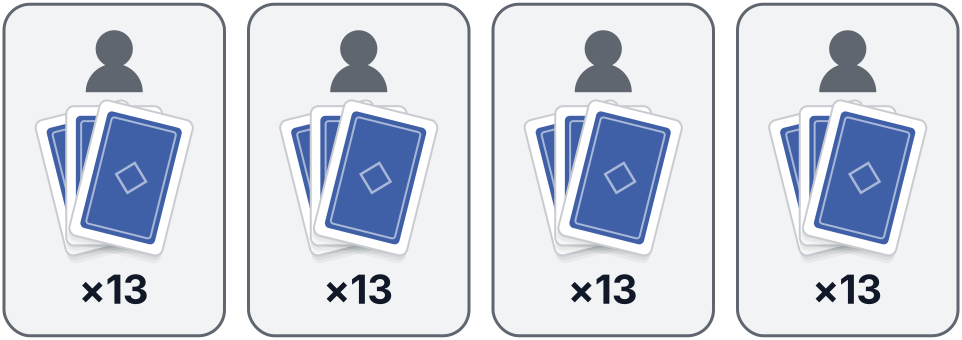
Cut the deck for the first dealer: highest card deals. The dealer shuffles and deals out the entire pack one card at a time, clockwise, until everyone holds 13 cards.
No card is turned up, since there is no trump suit to pick. Sort your hand by suit and keep it hidden. After each hand the deal moves clockwise.
The Bidding Round
Each hand opens with a round of bidding, starting with the player to the dealer's left. There are only two bids:
- Pass: The player wants a pass game, where the aim is to take as few tricks as possible.
- Grand: The player wants a grand game, where the aim is to take as many tricks as possible.
Bidding goes clockwise, and each player bids once at most. The moment someone says grand, the bidding is over and a grand game is played. If all four players pass, the hand is a pass game.
Grand carries risk: the bidding team can score well, but if the opponents end up with more tricks, they are paid double.
Playing Tricks
Who leads to the first trick depends on the bidding:
- In a grand game: The player to the right of the one who bid grand.
- In a pass game: The player to the dealer's left.
A trick works like this:
- The leader plays any card to the table.
- The others each add one card, clockwise.
- You must follow suit if you can. Holding a card of the suit led means you have to play one.
- With nothing in the suit led, you throw off any card, but it cannot win the trick.
- The highest card of the suit led takes the trick.
The winner gathers the four cards and leads to the next trick, through all 13. Pool each team's tricks so they are quick to count at the end.

Scoring
The first six tricks a team takes score nothing. Only the tricks beyond six count.
In a grand game:
- If the team that bid grand takes the most tricks, they score 1 point for each trick over six.
- If the opponents take the most tricks, they score 2 points for each trick over six.
Example: The bidding team takes 9 tricks and scores 3 points. If the opponents had taken 8 tricks instead, they would score 2 tricks over six times 2 = 4 points.
In a pass game each team scores 1 point for every trick fewer than six: take 4 tricks and your team scores 6 minus 4 = 2 points.
End of Game
After 13 tricks the hand is over. Note the score, pass the deal clockwise, and start the next hand with a fresh round of bidding.
Play continues until a team reaches 13 points, the usual target. That takes several hands, so agree on the target before you start. The first team there wins.
About this version
These rules cover the game as it is played in Norway: spoken bids of grand and pass, no trumps, double points to the opponents when a grand fails, and play to 13 points. English-language card game books list it as Norwegian Whist. The American branch, Minnesota Whist, bids with a hidden card instead, and the difference is described on this page.
Do you play with different rules where you live, or did you spot a mistake? Send me an email.
Similar games
Classic Whist
The original English trick game with trumps for four players in partnerships. The forerunner of Bridge.
Bridge (alias Contract Bridge or Rubber Bridge)
Bid your way to the right contract with your partner, then win the tricks you promised in trumps or notrump.
Oh Hell (alias Oh Pshaw, Rikiki, Elevator, Blackout, Contract Whist, Up and Down the River or Blob)
Trick-taking game where you bid exactly how many tricks to take. The catch is that someone always falls short.