Remi Card Game Rules
Remi is a card game for 3-5 players. A game typically takes 45-90 minutes, and the recommended age is 10+.
Rules for the card game Remi: Seven rounds, each with its own contract of sets and runs. Buy the cards others throw away and keep your score low. Remi is also known as Liverpool Rummy or Contract Rummy.
This page covers Remi, the seven round contract game known in English as Liverpool Rummy or Contract Rummy. The base game of the family lives at Rummy.
About the Game
Remi is a rummy game in seven rounds, and every round carries a contract of its own. The contract names the sets and runs you have to put on the table, and the whole thing has to go down in a single turn. What it asks for grows as the rounds pass, and the player with the fewest points at the end wins.
Three to five people can play, and four is the number the game is built for. You need two decks and jokers, and a full game runs 45 to 90 minutes. English speakers usually know this one as Contract Rummy or Liverpool Rummy. In Norway it is called Remi.
If Rummy is your reference point, three things are new here: the contract decides what you may lay down, runs need four cards, and a low score is the good one. 500 and Canasta come from the same family and have pages of their own.
What You Need
- Two decks of cards, 104 in all
- Nine jokers, which brings the pack up to 113 cards
- Three to five players, four for the best game
- Paper and a pen for the scores
Two decks rarely hold nine jokers between them, so most tables raid a third one. There is nothing wrong with playing on fewer, the gaps in a run are simply harder to plug. Some groups settle on one joker fewer than there are players.
Write down each round as you finish it and add everything up at the end. Seven rounds fill an evening.
Sets and Runs
There are two kinds of combination in Remi.
- A set is three or more cards of the same rank, say ♦️Q ♥️Q ♠️Q. Suits are irrelevant, and with two decks on the table the same card can turn up twice in one set.
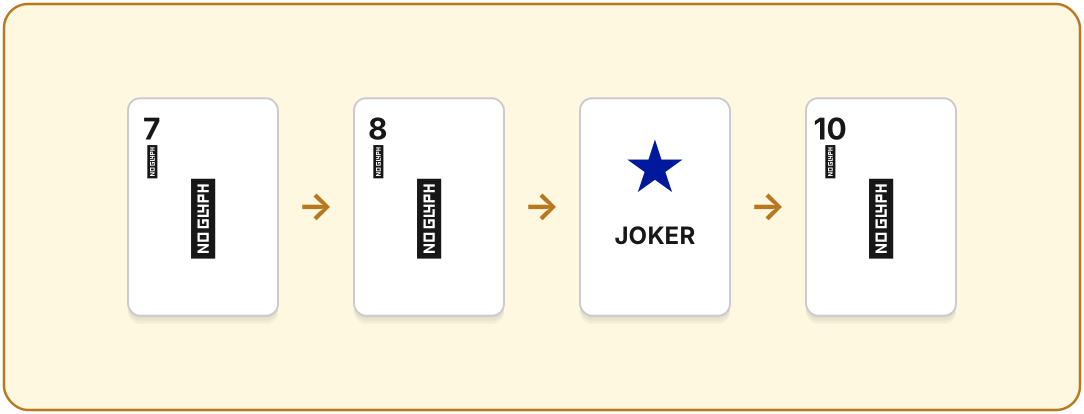
- A run is four or more cards of one suit in sequence, say ♠️7 ♠️8 ♠️9 ♠️10.
An ace works at either end of a run. ♣️A ♣️2 ♣️3 ♣️4 counts and so does ♥️J ♥️Q ♥️K ♥️A, but ♦️K ♦️A ♦️2 ♦️3 does not, since a run cannot turn the corner.
A joker fills in for whatever card you are missing. No combination may hold more jokers than real cards, so a three card set takes one joker at most and a four card run takes two.
The Seven Contracts
The rounds are named after the size of the combinations, and they always come in this order:
| Round | Name | Contract | Cards |
|---|---|---|---|
| 1 | 3-3 | Two sets | 6 |
| 2 | 3-4 | One set and one run | 7 |
| 3 | 4-4 | Two runs | 8 |
| 4 | 3-3-3 | Three sets | 9 |
| 5 | 3-3-4 | Two sets and one run | 10 |
| 6 | 3-4-4 | One set and two runs | 11 |
| 7 | 4-4-4 | Three runs | 12 |
The contract goes down in one turn, once in the round, using exactly the number of cards it asks for. Sitting on a fifth card for your run in round 2 means laying the four now and adding the fifth on your next turn.
What the contract counts is combinations. The point value of the cards has nothing to do with it.
The Deal
The dealer gives out one card at a time, clockwise. Ten cards each for the first six rounds, eleven for the seventh. The deal moves one seat to the left for every new round.
The rest of the pack goes face down in the middle as the stock, and the top card is turned over beside it to start the discard pile.
The player on the dealer's left goes first. That extra card in the last round is there because you draw before you lay down. Your hand is twelve when the moment comes, which is three runs of four exactly.
Taking Your Turn
A turn comes in four parts:
- Draw one card, either the top of the discard pile or the top of the stock. Reaching for the stock means the others get their chance to buy the discard first.
- Lay down the contract if you hold it. This happens once in the round and never again.
- Add cards to combinations already on the table, your own or anyone else's. You may only do this if your contract went down on an earlier turn.
- Discard one card face up. That ends your turn.
Take round 2, where the contract is one set and one run. Your hand is ♥️9 ♠️9 ♦️9 ♣️5 ♣️6 ♣️7 ♠️K ♦️4 ♥️2 ♠️8 and you draw ♣️8 from the stock. The set ♥️9 ♠️9 ♦️9 and the run ♣️5 ♣️6 ♣️7 ♣️8 are both complete, so down they go, and you throw the ♠️K. That leaves ♦️4 ♥️2 ♠️8 in your hand, ready to be played onto the table from your next turn.
Turns pass clockwise until somebody sheds their last card. Round 7 has no discard at all. There you go out by laying twelve cards as three runs, and the round ends on the spot.
Buying the Discard
First claim on the top of the discard pile belongs to whoever is on turn. The moment that player reaches for the stock instead, the card is open to everyone else.
A buy costs one extra card. Say that you want it, take it into your hand, and draw the top card of the stock along with it. That is the whole transaction. You may not meld and you may not discard, and the turn goes back to the player you interrupted.
When two people want the same card, it goes to the one who plays soonest after the current player. Once a buy is done, the card underneath is available on the same terms, but nobody may buy two cards in a row.
You come out of it one card closer to your contract and two cards further from an empty hand. Near the end of a round that arithmetic rarely works.
Jokers and Trading Them Back
Wherever a card is missing, a joker can take its place. Hold one when the round ends and it costs you 50 points, the steepest penalty in the game.
A joker sitting in a run on the table can be traded for. Hold the real card, with your contract already down from an earlier turn, and you can put the card in and pick the joker up. It has to go straight back out in the same turn, into a combination of your own or onto something already on the table.
An example: ♠️2 joker ♠️4 ♠️5 is lying there and the joker is standing in for ♠️3. Hold that ♠️3 and the swap is yours to make.
A joker in a set stays where it is. Once it lands there it is stuck for the rest of the round, no matter who turns up with the card it replaced.
Scoring and Ending a Round
The round stops the instant somebody plays their last card. Everyone else adds up what is left in hand:
| Card | Points |
|---|---|
| Joker | 50 points |
| Ace | 20 points |
| 10, jack, queen, king | 10 points |
| 2 to 9 | Face value |
The player who went out scores nothing for the round. Points here are penalties, so a blank line is the result you want.
An example: you go out in round 3. One opponent is caught with a joker, ♥️K and ♦️4, which comes to 64. Another holds ♠️A ♣️8 ♦️8 for 36. Combinations already on the table do not count, only what is still in hand.
Add the seven rounds together at the end. The lowest total wins the game.
About this version
These rules follow the Norwegian version of the game: two decks and nine jokers, seven fixed contracts, ten cards for the first six rounds and eleven for the last, with jokers worth 50 points and aces 20. The same game is played internationally as Contract Rummy, where the joker count, the hand size and the card values all differ. The usual departures are listed under variants.
Do you play with different rules where you live, or did you spot a mistake? Send me an email.
Similar games
Canasta
Collect seven matching cards into a canasta, build melds with your partner and race to 5000 points.
500 Rummy (alias 500, Rummy 500, 500 Rum or Pinochle Rummy)
Lay down groups and sequences, dig into the discard pile for the card you need, and pass 500 points first.
Schwimmen (alias Einunddreißig, Schnauz or Knack)
Swap with the three cards in the middle to reach 31 in one suit. Three lives each, last one left wins.