Blackjack Card Game Rules
Blackjack is a card game for 2-8 players. A game typically takes 20-45 minutes, and the recommended age is 10+.
Rules for the card game Blackjack: Get closer to 21 than the dealer without busting. Hit, stand, double or split while the dealer follows fixed rules. Blackjack is also known as 21 or Twenty-One.
This page covers the casino game Blackjack. Britain also uses the name Black Jack for a shedding game in the Crazy Eights family, which is a different game entirely.
About the game
Blackjack seats 2 to 8 people. One of them is the dealer, and everyone else plays against the dealer rather than against each other. You want a hand closer to 21 than the dealer's, without passing 21.
Pass it and the bet is gone at once, whatever the dealer ends up with. So every turn comes down to the same question: take another card, or settle for what you hold.
The game descends from the French vingt-et-un and picked up the name blackjack in American gambling houses around 1900. The story usually told is that some tables paid a bonus for an ace alongside a black jack. Card historians doubt it, but the name stuck.
Casinos deal Blackjack for money. At the kitchen table matchsticks do the job, and the deal moves round the table so nobody keeps the dealer's edge.
What you need
One 52-card pack with the jokers taken out. With six players or more, shuffle two packs together so the cards do not run out mid-round.
Something to bet with. Chips if you have them, otherwise matchsticks, buttons or dried beans. Hand everyone the same number and agree on a smallest and a largest bet before the first round.
The table splits in two: the dealer alone on one side, the players opposite, each with a bet in front of them where the dealer can see it.
Playing with a single pack, shuffle after every round.
Card values
Only the value counts. Suits (♠️♦️♣️♥️) do nothing at all in Blackjack.
- 2 to 10 count as the number on the card.
- Jack, queen and king count 10.
- An ace counts 1 or 11.
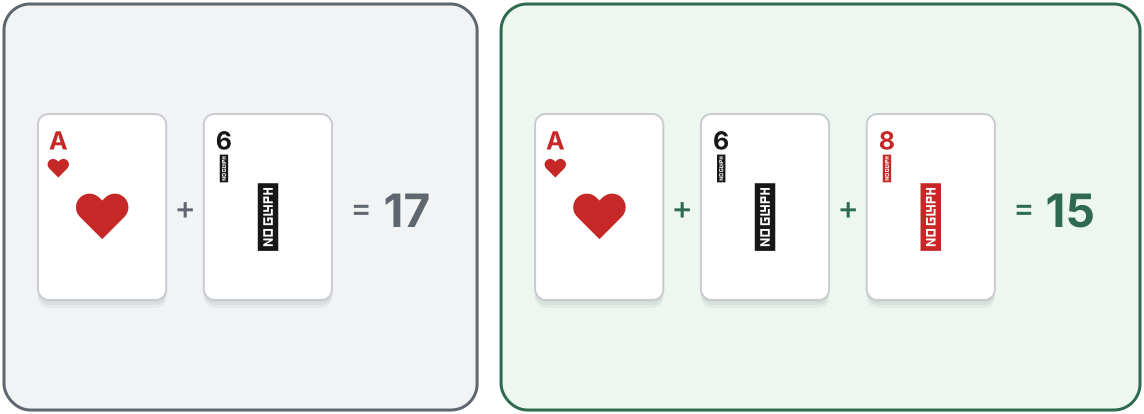
An ace counts 11 whenever the hand can carry it, so ♥️A with ♠️6 makes 17. Draw an 8 to that hand and the ace drops to 1, leaving you on 15 rather than bust.
A hand holding an ace counted as 11 is soft, and every other hand is hard. A soft hand cannot bust on the next card, which is worth keeping in mind before you wave a card away.
An ace with any ten-value card as your first two cards is a blackjack: 21 on two cards. It beats every other hand, including a 21 built from three.
Bets and the deal
Each player puts a bet down before a single card is dealt. The bet is what buys you into the round.
The dealer gives one card to each player and one to themselves, then goes round again: a second card to every player, and a second card to the dealer, face down this time.
The players' cards lie face up. The dealer keeps one card showing, the upcard, and one hidden, the hole card. That upcard is all you ever see of the dealer's hand while you make up your mind.
With an ace or a ten-value card showing, the dealer checks the hole card straight away. A blackjack there ends the round on the spot: every bet is lost, except that a player with a blackjack too gets the bet back.
Otherwise the players take their turns one at a time, beginning with the player on the dealer's left.
Your turn
On your turn you pick one of these:
- Stand: you are happy with the hand and take nothing more.
- Hit: one more card, and you may keep going while you are under 21. Go past it and the hand is bust, the bet is lost there and then, and play moves on.
- Double down: double the bet, take exactly one card, then stand on whatever it gave you. First two cards only, and worth doing mainly on 9, 10 and 11.
- Split: with two cards of the same value, match your bet and play them as two hands, each getting a fresh card. Finish the first hand before you start the second.
- Insurance: when the dealer shows an ace, you may stake half your bet on the hole card completing a blackjack. It pays 2:1, and it loses money over time, so most players skip it.
Split aces get one card each and nothing more. An ace with a ten-value card after a split counts as a plain 21, not a blackjack, and pays 1:1.
What the dealer must do
Once every player has stood or gone bust, the dealer turns the hole card over and plays. Nothing here is a choice, only two rules:
- 16 or less: the dealer has to hit.
- 17 or more: the dealer has to stand.
No doubling, splitting or insurance for the dealer either. Sitting on 16 with every player already standing on 20, the dealer still has to take a card.
A dealer who busts pays every hand still in the round, however small the total. A dealer who stands is measured against each hand in turn.
Soft 17, an ace with a six, is the one point the rules disagree on. Here the dealer stands on every 17. Some casino tables make the dealer hit soft 17, which hands the house a little more edge.
Settling up
The dealer settles with one player at a time:
- A blackjack pays 3:2. Stake 10 chips and you collect 15 on top of the stake.
- An ordinary win pays 1:1, so 10 chips staked win 10.
- The same total as the dealer is a push. The bet stays put and nothing changes hands.
- A bust hand was settled when it busted. The dealer going over afterwards does not bring it back.
- Insurance pays 2:1 when the dealer does turn out to have a blackjack.
Doubling counts the whole doubled bet towards the payout. After a split each hand settles on its own, and winning one while losing the other happens all the time.
Some tables pay a blackjack at only 6:5. Then 10 chips return 12 instead of 15, which costs the player far more than it appears to.
One round, card by card
Ben deals. Anna, Chris and Dina stake two chips each.
Anna gets ♠️K and ♦️7 for 17. Chris gets ♥️A and ♣️5, a soft 16. Dina gets ♦️8 and ♠️8. Ben lays ♣️9 face up on the table and one card face down.
Anna stands on 17, since anything above a 4 would bust the hand.
Chris hits and draws ♦️9. The ace falls to 1 and the hand is 15. One more card, ♠️4, makes 19, and Chris stands.
Dina splits the eights and puts up two more chips. The first eight draws ♥️3 for 11, then ♦️10 for 21. The second gets ♣️K and stands on 18.
Ben now turns the hole card: ♥️6, making 15. That is under 17, so Ben has to draw, and ♠️7 takes the hand to 22. The dealer is bust.
All four player hands win 1:1, both of Dina's included. Nobody held a blackjack, so nobody collects 3:2 this round.
Ending the game
Blackjack has no natural finish, so settle the shape of it before you start. At home the usual arrangement is to pass the deal once round the table, five rounds each or thereabouts.
There is a reason the deal moves clockwise. The dealer holds a small edge, because the players act first and a bust hand is lost before the hole card is even turned.
When the last round is done, everyone counts their chips and the biggest pile wins. A session like that runs 20 to 45 minutes, depending on how many are playing.
About this version
These rules describe casino Blackjack set up for a kitchen table: one pack, the dealer taking the hole card at once and standing on every 17, a blackjack paying 3:2 and insurance 2:1. Hitting, standing, doubling, splitting and insurance are all covered. The European deal, hitting soft 17, surrender, Five Card Charlie and the other table rules sit under variants and house rules.
Do you play with different rules where you live, or did you spot a mistake? Send me an email.