Poker Card Game Rules
Poker is a card game for 2-10 players. A game typically takes 30-60 minutes, and the recommended age is 12+.
Rules for the card game Poker: Learn every hand ranking from high card to royal flush, then play Texas Hold'em from the deal to the showdown. Poker is also known as Texas Hold'em or Hold'em.
This page covers the poker hand rankings and Texas Hold'em, the variant most people mean by poker. Rules for the dice version are at Poker Dice.
About the game
Poker is a family of games rather than a single one. They all share the same ranking of hands, but the way cards are dealt and bet on differs from one to the next. This page covers the rankings first, then teaches Texas Hold'em from the deal to the showdown, because that is the game almost everyone means today when they say poker.
Hold'em seats 2 to 10 players and works best with five to eight around the table. Two cards are dealt to you alone, and five more are turned face up in the middle for everybody. Out of those seven cards you put together the best five-card hand you can.
The prize is the pot, every chip that went in during the hand. Two routes lead there: hold the best hand when the cards come down, or bet in a way that makes everyone else fold. A single hand is over in a couple of minutes, and a game is many hands in a row.
What you need
One 52-card deck with the jokers taken out, shuffled before every hand.
Something to bet with. Proper poker chips are pleasant to handle, but matchsticks, buttons or dried beans work just as well at the kitchen table. Deal everyone the same number, say 100 chips each, and set the smallest bet at 2.
A marker for the dealer, known as the button. A face down card or a coin does the job. It moves one seat clockwise after every hand, so the jobs at the table come round to everyone equally often.
Agree on how the game ends before you start. At home the usual answer is that everybody starts with the same stack and play continues until one player holds every chip. If you only have an hour, count the chips when the time is up and the biggest stack wins. You can also double the blinds every fifteen minutes, which brings the game to a close on its own.
Hand rankings
A poker hand is always five cards. The categories below run from best to worst, and any hand in a higher category beats any hand in a lower one. Three twos are worth more than two pair of aces and kings.
| Hand | Example | What it is |
| Royal flush | A♠️ K♠️ Q♠️ J♠️ 10♠️ | The highest straight flush there is |
| Straight flush | 9♥️ 8♥️ 7♥️ 6♥️ 5♥️ | Five cards in sequence, all one suit |
| Four of a kind | 7♠️ 7♥️ 7♦️ 7♣️ K♠️ | All four cards of one rank |
| Full house | 9♠️ 9♥️ 9♦️ 4♣️ 4♠️ | Three of one rank with a pair of another |
| Flush | K♣️ J♣️ 9♣️ 3♣️ 2♣️ | Five cards of the same suit |
| Straight | Q♠️ J♦️ 10♥️ 9♠️ 8♣️ | Five cards in sequence, suits mixed |
| Three of a kind | Q♣️ Q♦️ Q♥️ 9♥️ 2♠️ | Three cards of one rank |
| Two pair | J♠️ J♣️ 4♦️ 4♥️ 8♠️ | Two pairs of different ranks |
| One pair | 6♠️ 6♥️ K♦️ 9♣️ 2♠️ | Two cards of the same rank |
| High card | A♠️ 10♦️ 8♣️ 6♥️ 3♠️ | None of the combinations above |
Most tables use the short names: quads for four of a kind, trips for three of a kind, and a boat for a full house.
The order follows how rare each hand is. A flush outranks a straight because five cards in sequence turn up more often than five of one suit, and a full house is rarer still than either.
The ace at both ends
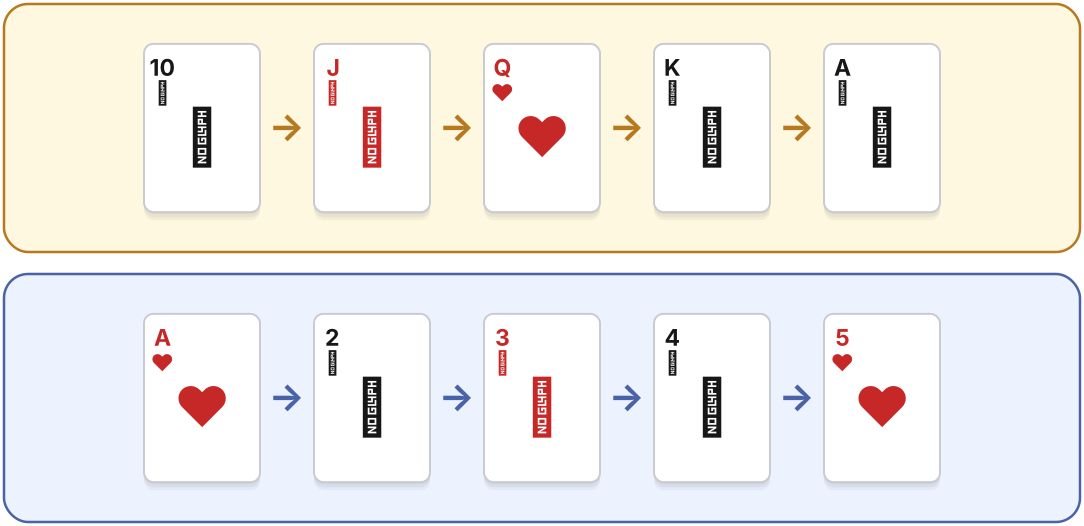
Aces are the highest single cards, ahead of the king, queen, jack, ten and so on down to the two. In a straight the ace is allowed to play at the bottom as well.
That makes A♠️ K♦️ Q♥️ J♠️ 10♣️ the highest straight and 5♥️ 4♠️ 3♦️ 2♣️ A♥️ the lowest. The low one is called the wheel, and its top card is the five rather than the ace, so any straight up to a six beats it.
What the ace cannot do is work at both ends of the same hand. 3♠️ 2♦️ A♥️ K♣️ Q♠️ is not a straight, because a sequence is not allowed to turn the corner.
Suits do not compete. A flush in spades has no claim over a flush in hearts, and K♠️ is worth no more than K♥️.
Breaking a tie
Two hands in the same category are separated by the ranks of their cards. Only the five cards in the hand matter, so when you pick five out of seven, as you do in Hold'em, the two you leave out count for nothing.
- Flush against flush: compare the top cards, then the second, and keep going down. K♠️ J♠️ 9♠️ 3♠️ 2♠️ beats K♦️ J♦️ 7♦️ 6♦️ 5♦️ on the nine against the seven.
- Straight against straight: the higher top card takes it.
- Full house against full house: the three of a kind settles it. 9-9-9-4-4 beats 8-8-8-A-A.
- Quads against quads: the higher four wins, and if those match, the fifth card decides. That fifth card is the kicker.
- Trips against trips: the higher three wins, then the two remaining cards.
- Two pair against two pair: top pair first, then the lower pair, then the odd card. J-J-2-2-4 beats 10-10-9-9-8, and 8-8-6-6-3 beats 8-8-5-5-K.
- Pair against pair: the pair first, then the three odd cards one at a time. J-J-A-9-3 beats J-J-A-8-7 on the nine against the eight.
- High card against high card: highest, then next highest, until something separates them.
When all five ranks match, the hands are equal and the pot is shared between the winners. Suits never break the tie. If the pot will not divide evenly, the spare chip goes to whichever winner sits closest to the left of the button.
The deal and the blinds
The button marks the dealer. To their left sits the small blind, and to the left of that the big blind, twice the size, say 1 and 2. Both are paid before anybody has seen a card, which puts something in the pot worth playing for.
Heads up, with only two players, it works the other way around. The dealer puts in the small blind and the other player the big blind.
The dealer burns the top card, meaning it goes to one side face down, then deals one card at a time clockwise until everyone holds two. Those two are yours alone. Look at them and keep them to yourself.
The big blind also fixes the smallest bet for the rest of the hand. At 1 and 2, no bet in any round can be smaller than 2 chips.
How a hand plays out
Four rounds of betting make up a hand. The first is pre-flop, and it opens with the player on the big blind's left, then moves clockwise. The blinds already count as bets, so the small blind only pays the difference to call, and the big blind acts last with the right to raise even after everyone else has called.
Next the dealer burns a card and lays three community cards face up. Those three are the flop. Betting starts again, this time with the first player still in the hand to the button's left, and it keeps that order for the rest of the hand.
Another burnt card, then a fourth community card called the turn, followed by a third round of betting.
One more time: a burnt card, the fifth community card known as the river, and the last round of betting.
With two or more players left, the hand goes to a showdown. The last player to bet or raise shows first. If the final round was checked all the way round, the first player left of the button shows first. You have to put both your cards face up to claim the pot, even when one of them or neither of them is doing any work.
The cards speak. Whatever the best hand shown is takes the pot, whether or not its owner realises it has won. Any five of the seven will do: both hole cards and three off the board, one and four, or the five board cards on their own, which is called playing the board.
What you can do on your turn
Your options when the action reaches you:
- Check: pass without putting in chips. Only available while nobody has bet in this round.
- Bet: put in the first chips of the round. The smallest bet is the size of the big blind.
- Call: match what the last player bet.
- Raise: put in more. A raise has to be at least as big as the bet or raise before it, so against a bet of 4 you can go to 8 or higher, but not to 6.
- Fold: push your cards away, giving up the hand and every chip you have already put in it.
A round of betting is finished once everyone still in has matched the same amount. If everybody folds but one player, the hand stops right there and that player takes the pot without showing anything.
How much you are allowed to bet is up to the table. No-limit lets you push in your whole stack whenever you like, and it is what most people play. Pot-limit caps a bet at the current size of the pot. Fixed-limit uses set amounts that double on the turn and the river, and gives the calmest game of the three.
Going all in and side pots
Short of chips to call? Push in what you have left and go all-in. You stay in the hand, but you can never win more from any opponent than you managed to put in yourself.
That calls for two pots. The main pot holds an equal amount from each player in the hand, capped at what the all-in player could cover. Anything beyond that goes into a side pot, which only the players with chips left can win.
Say three of you are left after the flop. Your stack is 100, Ben has 300 and Cara has 500. You go all-in for your 100 and both of them call. The main pot is 300 and all three of you are playing for it. Whatever Ben and Cara bet on the turn and the river builds a side pot the two of them contest alone. Win the showdown and you take the 300, while the better hand of Ben and Cara collects the side pot.
Bet more than anyone can cover and the excess comes straight back to you. Chips nobody is able to match are chips nobody can win.
One hand from start to finish
Four players, blinds of 1 and 2. Alice has the button, Ben puts in the small blind of 1, Cara the big blind of 2, and Dan sits on Cara's left.
Dan is first to act. Holding A♠️ K♠️, he raises to 6. Alice throws away 7♦️ 2♣️. Ben folds and gives up his blind. Cara looks at 9♥️ 9♦️ and calls by adding 4 to the 2 she has already paid. The pot stands at 13.
The flop comes K♥️ 9♠️ 4♦️. With Ben out, Cara is first to act. She has flopped three nines, and Dan has a pair of kings. Cara bets 6 and Dan calls, taking the pot to 25.
The turn is 7♣️. Cara bets 12, Dan calls, and the pot is 49.
The river is K♣️. Dan now holds three kings with an ace alongside them, a hand worth plenty of chips. The same card handed Cara a full house though, nines full of kings. She bets 20, Dan calls, and there are 89 chips in the middle.
Cara turns over 9♥️ 9♦️, Dan shows A♠️ K♠️, and the full house beats the trips. Cara scoops the 89. The king that gave Dan his trips is the very card that filled her full house.
About this version
These rules describe no-limit Texas Hold'em with a small and a big blind, two hole cards and five community cards, played with chips that carry no cash value. The hand rankings are the standard ones for a 52-card deck without jokers. Five-card draw, seven-card stud and Omaha are sketched under variants.
Do you play with different rules where you live, or did you spot a mistake? Send me an email.