Nomination Whist Card Game Rules
Nomination Whist is a card game for 2-5 players. A game typically takes 45-90 minutes, and the recommended age is 12+.
Rules for the card game Nomination Whist: bid exactly how many tricks you will win, then land on the number. One trick out either way scores nothing. Nomination Whist is also known as Bondebridge, Selbu Whist or Grip.
Britain uses the name Nomination Whist for more than one bidding game. This page covers the exact bidding game as Norway plays it, under the name Bondebridge, and the international form has its own page: Oh Hell.
About the Game
Nomination Whist is a trick-taking game for 2 to 5 players. Before each hand you announce how many tricks you intend to win, and then you have to land on that number. One trick too many is just as bad as one too few, and either way the hand scores nothing.
A full game runs to twenty hands. The number of cards you hold climbs from one up to ten and then drops back down to one.
These rules follow the Norwegian version of the game, called Bondebridge, and known there as Selbu Whist and Grip as well. The game turns up all over the world under other names, the best known being Oh Hell. Norway played its first national championship in it in Bergen in 2010.
What You Need
- A standard 52-card deck with the jokers removed
- Pen and paper for the bids and the running scores
- One player willing to keep score
The scorekeeper writes down the bids before each hand and adds up the points afterwards, so everyone can follow the standings as the game goes. Twenty hands take somewhere between forty-five minutes and an hour and a half.
Card Ranking
Cards rank the usual way inside each suit, from high to low:
♠️A ♠️K ♠️Q ♠️J ♠️10 ♠️9 ♠️8 ♠️7 ♠️6 ♠️5 ♠️4 ♠️3 ♠️2
Aces are always high. Any trump card beats any card of the other three suits whatever its rank, so with clubs as trumps a lowly ♣️2 takes the trick from ♠️A.
The Deal and the Twenty Hands
Settle the first dealer however you like. Rock paper scissors is the traditional method. After that the deal moves one seat clockwise for every new hand.
The dealer shuffles and deals one card at a time until everyone holds the right number for that hand. The pattern is fixed:
- Hands 1 to 10: one card in the first hand, two in the second, rising to ten cards in hand 10.
- Hands 11 to 20: ten cards again in hand 11, nine in hand 12, falling back to a single card in hand 20.
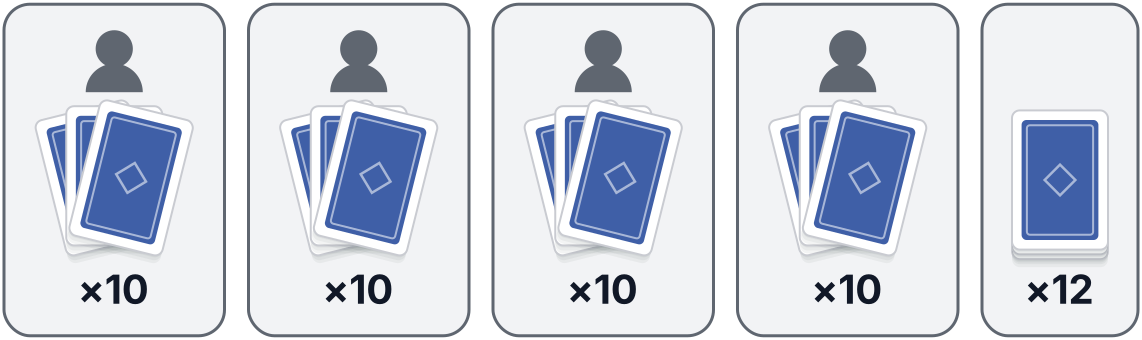
That makes twenty hands with the two big ones back to back in the middle. The undealt cards are set aside. There is not much left over in the ten-card hands: four players leave 12 cards out of play, five players only 2.
Trumps Hand by Hand
The three shortest hands at each end are played without trumps. That covers hands 1, 2 and 3, with one, two and three cards, and hands 18, 19 and 20, with three, two and one. In those hands the highest card of the suit led simply wins.
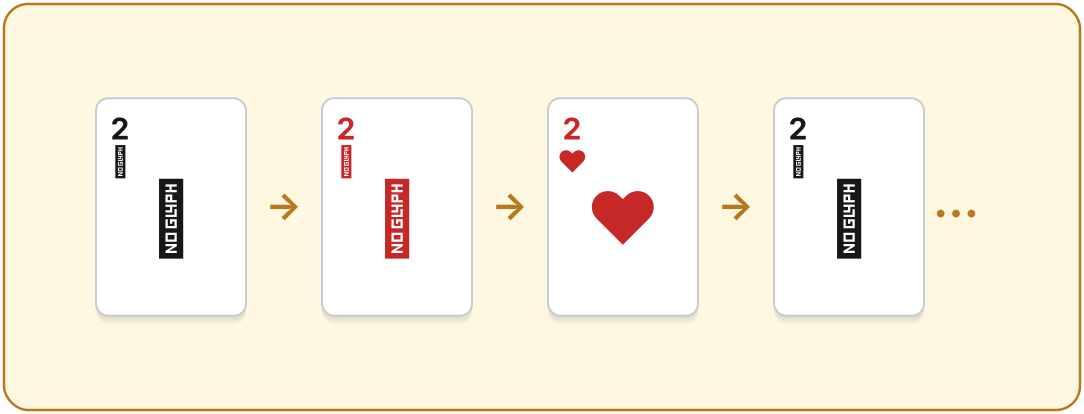
Hands 4 through 17 have trumps, and the trump suit cycles in a fixed order: clubs, diamonds, hearts, spades, then round again. Hand 4 is clubs, hand 5 diamonds, hand 6 hearts, hand 7 spades, hand 8 back to clubs, and so on until hand 17, which is diamonds.
With two, three or four players, take the four twos out of the deck and lay them out in that order. The current trump is then visible on the table and nobody has to keep count. Five players cannot do this, because the ten-card hands need every one of the 52 cards.
Bidding
Everyone bids at the same moment, so nobody gets to react to anybody else's number.
- Look at your hand and decide on a number.
- Put a closed fist on the table.
- One player counts to three, and on three everybody shows their bid on their fingers. A closed fist means zero.
- The scorekeeper writes the bids down.
Any number from zero up to the size of your hand is allowed. Passing is not. A bid of zero commits you to winning no tricks at all.
What the bids may not do is add up to the number of cards in the hand. When they do, the player to the dealer's left has to move their bid one trick up or down. Every hand is therefore either overbid or underbid, and at least one player is going to fail.
Example: four players, six cards each, and the bids come out as 2, 1, 2 and 1. That is six tricks bid for six available. The player on the dealer's left bid 1 and now has to say 2 or 0 instead. The scorekeeper then calls out whether the hand ended up over or under.
Playing the Tricks
The player to the dealer's left leads to the first trick and may lead anything, trumps included. Play then goes clockwise, and nobody plays out of turn.
- Follow the suit that was led if you hold it.
- If you are void in that suit, discard from another suit or play a trump.
- The highest trump takes the trick. With no trump in it, the highest card of the suit led wins.
- Whoever wins a trick leads to the next one.
Keep the tricks you win in a neat pile in front of you, spread out enough to be counted at a glance. Anyone may ask what the others bid and how many tricks they have won so far.
Example: hearts are trumps. The player on the dealer's left opens with ♠️K. You are out of spades and put ♥️3 on it. The next player follows suit with ♠️A. The trick is still yours, because even a small trump outranks the biggest card in the suit led.
Scoring and the End of the Game
Points come only from an exact hit. Land on your bid and you score 10 points plus one point for every trick you bid. Miss it in either direction and the hand is worth nothing.
| Bid | Won | Score |
|---|---|---|
| 0 | 0 | 10 |
| 4 | 4 | 14 |
| 4 | 5 | 0 |
| 4 | 3 | 0 |
Your bid therefore decides what the hand is worth to you. A clean zero pays 10 and a bid of five brought home pays 15, so an ambitious bid is worth making when the cards support it.
Scores accumulate, and the scorekeeper updates the standings after every hand. The highest total after hand 20 wins the game.
About this version
These rules describe the Norwegian form of the game, known there as Bondebridge: twenty hands running from one card up to ten and back, simultaneous bidding on fingers, a fixed trump cycle with three no-trump hands at each end, and 10 points plus your bid for an exact hit. Plenty of groups turn a card for trumps instead, and some play fewer hands. Both appear under variants. The name Nomination Whist is also used in Britain for other bidding games.
Do you play with different rules where you live, or did you spot a mistake? Send me an email.
Similar games
Amerikaner
Trick-taking game where you bid on number of tricks and cooperate with a partner. First to 52 points wins.
War (alias Bataille, Guerra or Battle)
Flip cards, highest wins. When cards match, it triggers a war for all the cards on the table. Simple enough for all ages.
Oh Hell (alias Oh Pshaw, Rikiki, Elevator, Blackout, Contract Whist, Up and Down the River or Blob)
Trick-taking game where you bid exactly how many tricks to take. The catch is that someone always falls short.