Pyramid Solitaire Rules
Pyramid Solitaire is a solitaire game for 1 player. A game typically takes 5-15 minutes, and the recommended age is 8+.
Rules for the solitaire Pyramid Solitaire: Pair up cards that add to 13 and take the pyramid apart. Kings need no partner at all. Pyramid Solitaire is also known as Pyramid, Pile of Twenty-Eight or Tower of Twenty-Eight.
About the game
Pyramid Solitaire is played on a triangle of 28 face-up cards. You clear it by taking cards away in pairs that add up to 13, with aces counting 1, jacks 11, queens 12 and kings 13. A king is already 13, so it leaves on its own. One player, one deck, and rarely more than a quarter of an hour.
The rules take a minute to learn. Getting the pyramid down to nothing is the hard part, and most attempts end with cards still on the table. The game turned up in American solitaire books around 1930, sometimes as Pyramid, sometimes as Elizabeth's Solitaire or Tower of Twenty-Eight, and it settled into the standard repertoire after Albert Morehead and Geoffrey Mott-Smith included it in their 1949 collection. Most people meet it on a phone these days.
What you need
- A standard 52-card deck with the jokers taken out
- Enough table for a pyramid seven cards wide along the bottom
You also need room beside it for three small piles: the stock, the waste and the cards you have removed. Any kitchen table will do.
Card values
Suits play no part. Only the rank counts:
- Ace = 1
- 2 through 10 = face value
- Jack = 11
- Queen = 12
- King = 13
That fixes the pairs once and for all: ace with queen, 2 with jack, 3 with 10, 4 with 9, 5 with 8, and 6 with 7. A king needs no partner at all.
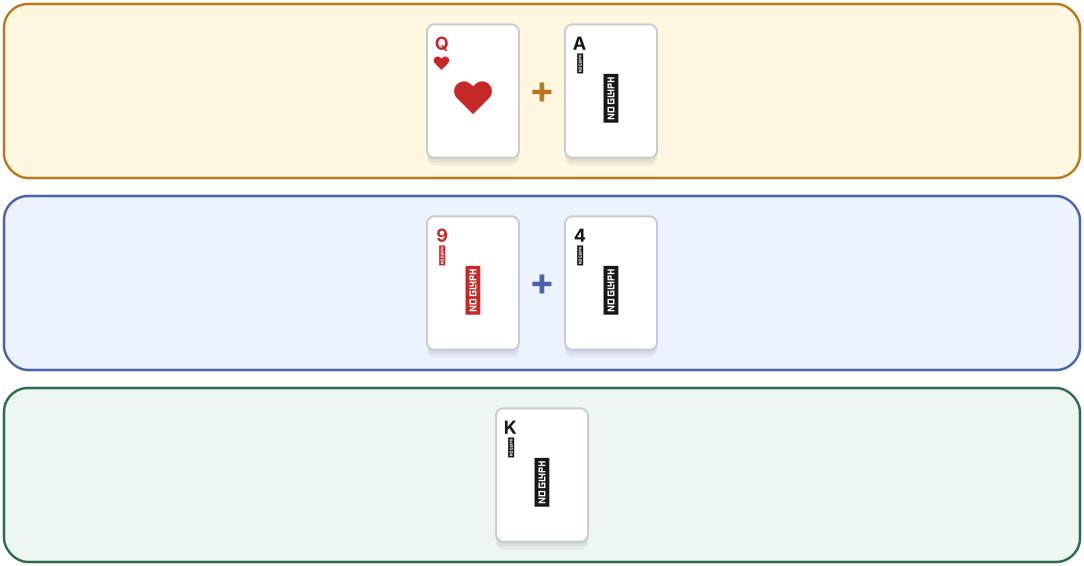
Dealing the pyramid
Shuffle and lay out 28 cards face up in seven rows: one card at the top, two below it, three below those, down to a bottom row of seven. Offset each row by half a card so that every card rests on two cards from the row above it.
The result is that every card in the pyramid is covered by two others, except the seven along the bottom, which lie clear.
Put the remaining 24 cards face down beside the pyramid as the stock. Cards you turn up and cannot use start a waste pile next to it, and the pairs you take away go in a heap of their own. Once a card has been discarded it is out of the game for good.
Which cards are in play
Only uncovered cards can be taken, and a pyramid card counts as uncovered when both of the cards lying on it have gone. One of them left in place is enough to keep it stuck.
The bottom seven are uncovered from the start. Take away two neighbouring cards there and the card they were covering in the row above comes free. The single card at the top is the last one you can reach.
Cards at the end of a row cover only one card each, while the ones in the middle of a row cover two. Clearing towards the middle therefore opens the pyramid faster than nibbling at the edges.
Two more cards are live at any time: the card you have just turned from the stock, and the card on top of the waste pile.
Taking your turn
Look the pyramid over before you touch anything. Then make as many moves as you like among the cards that are already uncovered:
- Take away two uncovered cards that add up to 13
- Take away an uncovered king by itself
When the pyramid has nothing more to offer, turn the top card of the stock. It is in play the moment it is face up. If it matches an uncovered pyramid card, or the card on top of the waste, the two go off together. If it matches nothing, it goes on top of the waste and you turn the next one.
Say the bottom row reads ♥️K, ♠️5, ♦️J, ♣️2, ♠️Q, ♦️4 and ♣️6. The king goes straight out. The ♦️J and ♣️2 make 13 and leave together, and since they sit side by side they uncover a ♥️A in the row above, which is exactly what the ♠️Q was waiting for. Now turn the stock: up comes ♣️8 and takes the ♠️5. The next card is a ♦️10, nothing uncovered matches it, so it starts the waste pile. Turn a ♥️3 after that and the two of them leave together straight from the waste.
The stock and the waste pile
The stock is turned one card at a time, and the traditional game gives you a single pass through it. The waste is never picked up and dealt again, so each card gets its chance while it sits on top.
There is still a way to dig. When you use the card on top of the waste, the one underneath comes back into play, which is why matching a fresh stock card against the waste is worth more than it looks. Turn a card you cannot use, on the other hand, and it buries whatever was on top.
The game ends when the last stock card has been turned and no pair is left to take. If you want more passes, see Par Pyramid under the variants.
Winning and losing
You win by discarding all 52 cards, the pyramid and everything that came out of the stock. That does not happen often, which is the point of the game.
Apps and browser versions usually stop at the pyramid: clear those 28 cards and the deal counts as won, whatever is left over. It is an easier target and a variant in its own right rather than the traditional rule. Decide which one you are playing before you deal, or your results will not mean much next time.
Anything else is a loss. Once the stock is empty and no pair is left to take, cards still standing in the pyramid end the deal.
Scoring several deals
Morehead and Mott-Smith added a score so that a run of deals adds up to something, even though most of them fall short. It belongs to Par Pyramid, the version where the waste can be turned over twice.
- 50 points for clearing the pyramid on the first pass
- 35 points on the second pass
- 20 points on the third
- 0 points if the pyramid never comes down
Then take off one point for every card still on the table when you stop. Finish six deals on zero or better and you have had a good session.
About this version
These rules follow the traditional game: a 28-card pyramid, one pass through the stock a card at a time, and a win only when all 52 cards have been discarded. Par Pyramid with its three passes, the version that stops at the pyramid, and overlap discards are all covered under variants.
Do you play with different rules where you live, or did you spot a mistake? Send me an email.
Similar games
Klondike (alias Solitaire, Patience, Canfield or Windows Solitaire)
The world's most widely known solitaire. Move all 52 cards to foundations, sorted by suit from Ace to King.
FreeCell (alias Kungen or Admirális)
A skill-based solitaire where every card is visible from the start. 99% of deals are winnable.
Gaps (alias Montana, Addiction or Spaces)
Arrange all cards in ascending order by moving them through empty spaces, but be careful not to block yourself.