500 Rummy Card Game Rules
500 Rummy is a card game for 2-8 players. A game typically takes 30-60 minutes, and the recommended age is 8+.
Rules for the card game 500 Rummy: Lay down groups and sequences, dig into the discard pile for the card you need, and pass 500 points first. 500 Rummy is also known as 500, Rummy 500, 500 Rum or Pinochle Rummy.
This page covers 500 Rummy, not the Australian trick-taking game Five Hundred.
About the Game
500 Rummy belongs to the rummy family and works with 2 to 8 players, though it is at its best with three to five. You collect groups and sequences of cards and lay them face up in front of you. Melded cards earn points, cards left in your hand count against you, and the first player past 500 points wins.
A turn takes seconds: draw, meld, discard. Anyone who has played Rummy will recognise most of it. What sets 500 Rummy apart is the discard pile. You may reach for a card buried deep in it, as long as you also pick up every card lying on top, and those all go into your hand.
What You Need
- A standard 52-card deck with the jokers removed
- Two decks shuffled together once five or more people play
- Pen and paper for the running scores
Scores accumulate over several rounds, so write them down as each round ends. Reaching 500 usually takes about half an hour, and closer to an hour with a full table.
Groups and Sequences
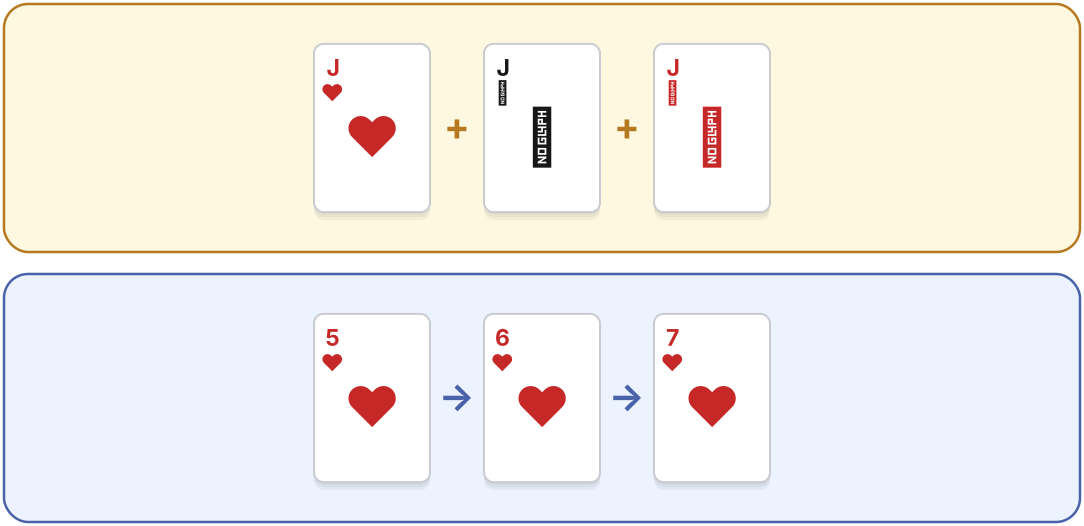
A meld is three or more cards laid face up on the table in front of you. Two kinds count:
- A group of three or four cards of the same rank, such as ♥️J ♣️J ♦️J. Suits are irrelevant here.
- A sequence of three or more cards in one suit running in order, such as ♥️5 ♥️6 ♥️7.
Aces work at either end. ♦️A ♦️2 ♦️3 counts, and so does ♣️Q ♣️K ♣️A. Sequences never turn the corner, which rules out ♠️K ♠️A ♠️2.
With two decks in play, a group must have four different suits, so ♠️6 ♠️6 ♥️6 is no good. Groups and sequences are also known as sets and runs.
Card Values
A card is worth the same on the table as in your hand. On the table it adds, in your hand it subtracts.
| Card | Value |
|---|---|
| 2 through 9 | 5 points |
| 10, J, Q, K | 10 points |
| Ace | 15 points |
| Ace played low in a sequence with 2 and 3 | 5 points |
An ace costs you three times what a five does if the round ends while you still hold it. Suits never affect the score.
The Deal and Setup
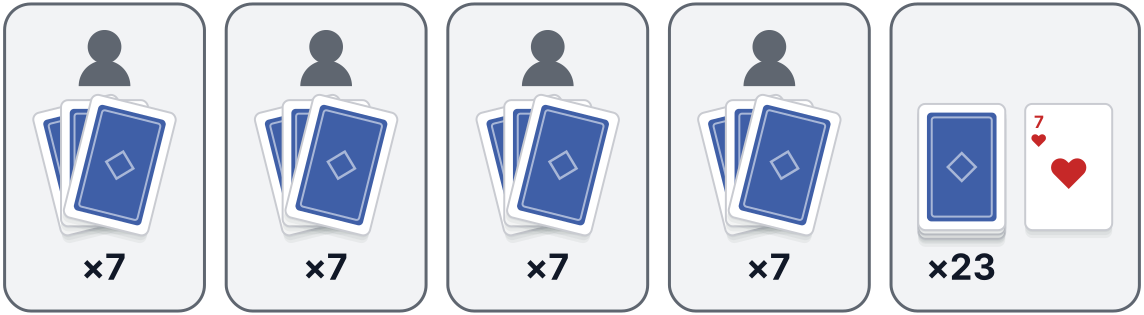
The dealer hands out seven cards each, one at a time, going clockwise. In a two-player game each side gets thirteen cards instead.
The rest of the deck goes face down in the middle of the table as the draw pile. Flip its top card face up beside it, and that card starts the discard pile.
Spread the discard pile out so every card stays visible. You need to see what is buried in there to plan a turn. The player on the dealer's left begins, play moves clockwise, and the deal passes on to the next player for the following round.
How to Play
Every turn has three parts, in this order:
- Draw, either the top card of the draw pile or cards from the discard pile.
- Meld what you want to meld, and add cards to melds already on the table if you can.
- Discard one card face up on the discard pile.
Drawing and discarding are compulsory. Melding is not, but unmelded cards turn into minus points, so getting them down pays off.
If you only took the top card of the discard pile, you have to discard some other card, not the one you just picked up.
Example: your hand is ♥️5 ♥️6 ♥️7 ♠️K ♦️K ♣️2 ♦️9 and you draw ♥️K from the pile. Down go the sequence ♥️5 ♥️6 ♥️7 and the group ♠️K ♦️K ♥️K, and you throw ♣️2. That leaves ♦️9 in hand and 45 points on the table.
Digging into the Discard Pile
The top card of the discard pile is always yours for the taking. Reaching further down comes with two conditions:
- You take every card sitting above the one you want.
- You put that card to work straight away, in a new meld or added to a meld on the table.
The cards you scooped up along the way can be melded in the same turn if they fit. Otherwise they stay in your hand.
Example: the discard pile runs ♣️5 ♥️A ♠️K ♥️3 ♠️Q ♦️4, with ♦️4 on top, and you hold ♣️3 ♦️3. Take ♥️3 plus the two cards above it, ♠️Q and ♦️4, then meld the group ♥️3 ♣️3 ♦️3. ♠️Q and ♦️4 join your hand.
Two extra cards get expensive if nothing comes of them, so do the arithmetic before you dig. The deeper the card, the bigger the bill.
Laying Off on Existing Melds
Every meld on the table is fair game for everyone. On your turn you can complete a group of three with its fourth card, or extend a sequence at either end.
Place the card in front of yourself rather than next to the meld it belongs to. The points are yours even when someone else laid the meld.
Example: ♥️5 ♥️6 ♥️7 sits on the table. Holding ♥️4 or ♥️8 lets you play one of them, or both, in the same turn. When a card fits more than one meld, name the meld before you put the card down. With ♣️7 ♣️8 ♣️9 and ♦️10 ♥️10 ♠️10 both on the table, your ♣️10 can serve either one, and you decide which.
No meld of your own is required first. If the card fits, you can lay it off from your very first turn.
Scoring and Ending the Round
The round stops the moment a player plays or discards their last card. It also stops if the draw pile is empty when somebody has to draw. Nothing more may be melded after that, and cards you were about to play count against you like any other.
Each player adds up the cards they melded and subtracts the cards still in hand. A hand fuller than your table gives you a negative round, and a running total can dip below zero.
Example: you have melded ♦️7 ♦️8 ♦️9 ♦️10 and ♣️J ♦️J ♥️J, laid ♥️A off on somebody else's group of aces, and hold ♠️3. Your round comes to 25 + 30 + 15 - 5 = 65 points.
Deal again until at least one player is past 500 points. The session ends there and the highest total wins. If two players tie at the top, play one more round.
About this version
These rules cover 500 Rummy as it is usually played in the Nordics: 52 cards without jokers, seven cards each, values of 5, 10 and 15 points, and the win to the first player past 500. Wild jokers and face value scoring are common house rules and appear under variants. Card game books call the same game 500 Rum.
Do you play with different rules where you live, or did you spot a mistake? Send me an email.
Similar games
Remi (alias Liverpool Rummy or Contract Rummy)
Seven rounds, each with its own contract of sets and runs. Buy the cards others throw away and keep your score low.
Stress (alias James Bond or Atlantis)
Swap cards with the four in the middle until every pile holds four of a kind, then shout Stress before anyone else.
Schwimmen (alias Einunddreißig, Schnauz or Knack)
Swap with the three cards in the middle to reach 31 in one suit. Three lives each, last one left wins.