Rummy Card Game Rules
Rummy is a card game for 2-6 players. A game typically takes 20-40 minutes, and the recommended age is 7+.
Rules for the card game Rummy: Collect groups and runs, empty your hand first and score the cards everyone else is left holding. Rummy is also known as Rum, Straight Rummy or Basic Rummy.
This page covers basic Rummy. 500 Rummy, Remi, Gin Rummy and Canasta are separate games in the same family, each with a page of its own.
About the Game
Rummy is the game that gave the whole rummy family its name. You collect groups and runs of cards, lay them face up on the table and try to empty your hand before anyone else. Whoever gets rid of their last card first scores the cards the other players are still holding. Anything from 2 to 6 people can play, and the game is at its best with two to four.
The rhythm is easy to pick up. Every turn you take a card, get down whatever you can, and let a card go. This page sticks to the plain version, usually called Straight Rummy. 500 Rummy, Remi and Canasta all build on it, each with its own deal and its own way of counting points.
What You Need
- One standard deck of 52 cards, jokers removed
- 2 to 6 players
- Paper and a pen for the running score
Scores carry from round to round, so note them down as you go. Settle on a finish line before the first deal, say 100 points, or agree on a fixed number of rounds instead. A full game usually runs 20 to 40 minutes.
Card Ranking and Values
The ace is the lowest card here and the king the highest: A, 2, 3, 4, 5, 6, 7, 8, 9, 10, J, Q, K. That matters for runs. ♠️A ♠️2 ♠️3 is fine, while ♠️Q ♠️K ♠️A is not a run at all.
Whatever is left in your hand when the round stops goes to the player who went out:
| Card | Points |
|---|---|
| Ace | 1 point |
| 2 to 10 | Face value |
| Jack, queen, king | 10 points |
A king left in your hand costs ten, an ace next to nothing, and the suits never enter the count.
The Deal and Setup
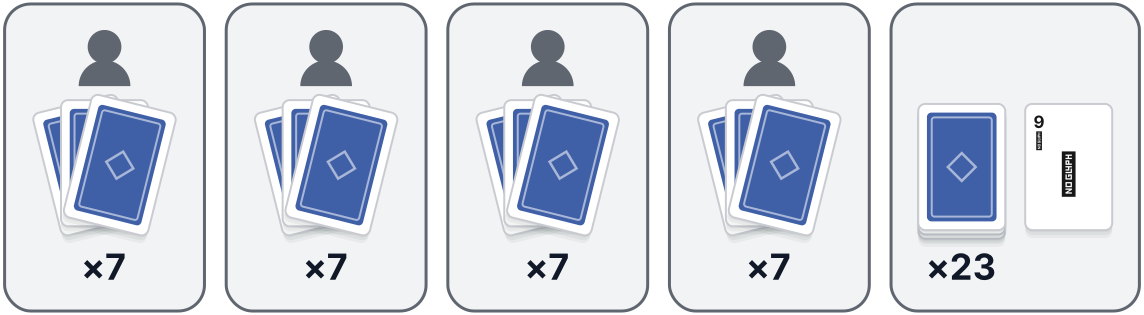
The dealer hands out cards one at a time, clockwise. How many depends on the size of the table:
- 2 players: 10 cards each
- 3 or 4 players: 7 cards each
- 5 or 6 players: 6 cards each
Turn the next card face up beside the deck. That card opens the discard pile, and the rest of the deck stays face down as the stock.
With two players the non dealer plays first, and the two of you take turns dealing. With more players the person to the dealer's left starts, play goes clockwise, and the deal shifts one seat left each round.
Groups and Runs
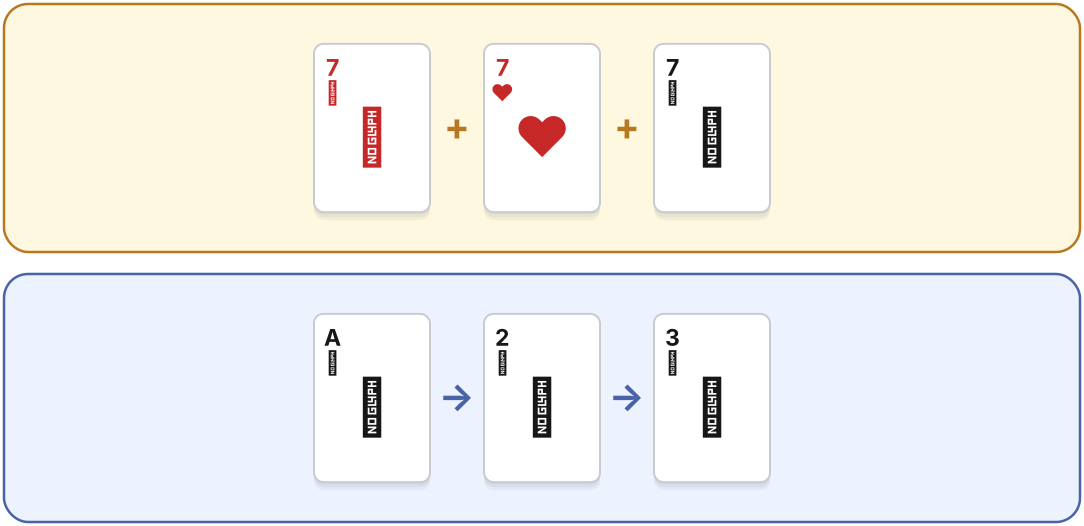
Melds are the combinations you put on the table, three cards at a minimum, always face up in front of you. There are two kinds:
- A group: three or four cards of the same rank, such as ♦️7 ♥️7 ♠️7. Suit is irrelevant, and since a deck holds four of each rank, a group never grows past four cards.
- A run: three or more cards in the same suit, following one another, such as ♣️A ♣️2 ♣️3. Add enough cards and a run can cover the whole suit.
A run is fenced in at both ends. Aces belong below the two and never above the king, and no run bridges the two, so ♥️K ♥️A ♥️2 does not count.
How a Turn Works
Every turn follows the same four steps in order:
- Draw one card, either the top of the stock or the top of the discard pile. Drawing is compulsory.
- If you want to, lay down one meld from your hand. This part is optional.
- Add as many cards as you like to melds already on the table. Optional as well.
- Throw one card face up on the discard pile. Discarding is compulsory.
If you took the top card of the discard pile, something else has to go this turn. Throwing that same card away on a later turn is fine. A card drawn from the stock can go straight back out again if that suits you.
An example: your hand is ♦️7 ♥️7 ♠️4 ♠️5 ♣️K ♦️2 ♥️9 and you draw ♣️7 from the stock. Down goes the group ♦️7 ♥️7 ♣️7, and out goes ♣️K. That leaves four cards in your hand, and the ten points the king would have cost you are gone with it.
Laying Off on Melds Already on the Table
Every meld on the table belongs to everybody. On your turn you can complete a group of three with the missing fourth card, or extend a run at either end. There is no limit to how many cards you lay off in one turn, and you do not need a meld of your own first.
Say ♣️4 ♣️5 ♣️6 is on the table. Your ♣️3 goes on the bottom end, your ♣️7 on the top end, and if you hold both, both leave your hand in the same turn.
Nothing on the table can be rearranged, only extended. With ♠️2 ♠️3 ♠️4 lying there and ♦️2 ♥️2 in your hand, pulling ♠️2 out of the run to start a group of twos is not allowed.
When the Stock Runs Out
Sooner or later the stock runs dry with nobody out. The next player then has a choice: take the top card of the discard pile, or flip the whole pile over and use it as a fresh stock. Nobody shuffles it, so the cards come back in the reverse of the order they were thrown away. Anyone who paid attention now has a fair idea of what is coming.
The first discard after that starts a new pile, and the round carries on as before.
Going Out and Scoring
Getting rid of your last card is called going out, and three routes lead there: the card completes a new meld, it lands on a meld already on the table, or you simply discard it. Keeping a spare card back for the discard pile is not required.
The round stops as soon as somebody goes out. Nothing more may be laid down, even by a player holding a finished meld.
Everyone else adds up what they still hold, and the whole total goes to the player who went out.
An example: you go out, and the other three are left with ♥️K ♠️4, ♦️A ♦️3 ♣️8 and ♠️J ♠️Q ♥️2. Those hands come to 14, 12 and 22, so the round pays you 48 points.
Empty your entire hand in a single turn, having melded and laid off nothing earlier in the round, and you have gone rummy. That doubles what the round pays you. With one new meld allowed per turn it takes an unusual hand, because everything beyond that meld has to fit onto cards already showing.
Keep dealing rounds until somebody reaches the target you agreed on. Highest score at that point wins the game.
About this version
These rules cover basic Rummy: 52 cards without jokers, the ace as the lowest card, one new meld per turn, and the points going to whoever goes out. That is the version the card game books file under Straight Rummy. Laying down several melds in a turn and having to keep a card back to discard are widespread house rules, and both are listed under variants.
Do you play with different rules where you live, or did you spot a mistake? Send me an email.
Similar games
31 (alias Thirty-One, Scat or Blitz)
Tactical card game with 3 lives per player. Collect high cards of the same suit and knock at the right time to survive.
Pig (alias Spoons or Donkey)
Collect five cards of the same suit, then quietly signal. The last player to notice loses a letter in P-I-G.
Old Maid (alias Schwarzer Peter or Baba Nuki)
Form pairs to discard your cards, but don't get stuck with the Queen of Clubs.