Gin Rummy Card Game Rules
Gin Rummy is a card game for 2 players. A game typically takes 20-45 minutes, and the recommended age is 8+.
Rules for the card game Gin Rummy: Collect sets and runs hidden in your hand, knock when your deadwood is low, and race your opponent to 100 points. Gin Rummy is also known as Gin.
This page covers Gin Rummy, the two player game where a knock ends the round. The name is also used for 500 Rummy, and the basic game of the family is under Rummy.
About the Game
Gin Rummy is a two player game where the sets and runs you collect stay in your hand rather than going face up on the table. All your opponent gets to see is what you throw away, and your hand is only revealed once the round is over. The aim is to work as many of your ten cards as possible into melds and then end the round while the leftovers count for little.
The game came out of New York around 1911, put together by a bridge player called Elwood T. Baker, and his son named it Gin after the drink. Hollywood took it up in 1941, and it has been one of the most played two player card games ever since.
Rounds are short, a few minutes each, and a game is however many of them it takes for somebody to reach 100 points. That usually lands somewhere between 20 and 45 minutes.
What You Need
- One standard deck of 52 cards, jokers removed
- 2 players
- Paper and a pen for the running score
Scores carry across the whole game, so draw two columns and write the numbers down after every round. The game finishes when one of you passes 100 points, which usually takes four to eight rounds.
Card Ranking and Values
The ace is the lowest card and the king the highest: A, 2, 3, 4, 5, 6, 7, 8, 9, 10, J, Q, K. An ace sits below the two and never above the king, so ♥️A ♥️2 ♥️3 is a run while ♥️Q ♥️K ♥️A is not, and no run bends round the corner.
Cards you cannot fit into a meld are called deadwood, and those are what you count when the round stops:
| Card | Points |
|---|---|
| Ace | 1 point |
| 2 to 10 | Face value |
| Jack, queen, king | 10 points |
A king stuck in your hand costs ten points and an ace only one. Suits never enter the count.
The Deal and Setup
Draw a card each to settle who deals. Low card deals the first round, and after that the winner of the previous round deals.
The dealer gives ten cards to each player, one at a time. Card number 21 is turned face up on the table and opens the discard pile. What remains of the deck goes face down beside it as the stock.
That leaves ten cards in each hand, one face up card between you, and 31 cards in the stock.
Sets and Runs
A meld is three cards at a minimum, and it comes in two shapes:
- A set: three or four cards of the same rank, such as ♠️7 ♥️7 ♦️7. Suits are irrelevant here.
- A run: three or more cards of the same suit following one another, such as ♣️9 ♣️10 ♣️J.
No card can serve in two melds at once. Holding ♥️7 ♠️7 ♦️7 ♥️8 ♥️9, the seven of hearts belongs either to the set of sevens or to the heart run, never to both. Getting the set and the run together takes one more card: ♣️7 or ♥️10.
Your melds stay hidden in your hand for the whole round. Nothing is laid down as you go, and everything reaches the table at the moment the round ends. That is where Gin Rummy parts company with Rummy, in which melds go straight onto the table.
The First Turn
The opening turn of a round works differently, and it is all about the face up card:
- The player who did not deal decides first. Take the card and you throw another one away, and the dealer plays next.
- Turn it down and the dealer may take it instead, discard a card, and then it is your turn.
- If neither of you wants it, the player who did not deal takes the top card of the stock and discards. The dealer then carries on.
From there the turns run normally. Taking the face up card costs you a little secrecy, since your opponent sees exactly what you picked up and can guess what you are collecting.
How a Turn Works
An ordinary turn has two halves, and neither is optional:
- Draw one card, either the top of the stock or the top card of the discard pile.
- Throw one card face up on the discard pile.
The discard pile lies open, so you know what you are getting from it. The stock is face down, and there you commit before you see the card. Take the top discard and something else has to go the same turn, though you are free to throw that card away later in the round.
Only the top card of the discard pile is in play. The pile is kept squared up, and nobody may leaf through it to check what went before. Remembering it is part of the game.
An example: your hand is ♠️4 ♠️5 ♦️K ♦️9 ♣️2 ♥️Q ♥️J ♥️10 ♣️7 ♦️7 and you draw ♠️6 from the stock. That gives you the runs ♠️4 ♠️5 ♠️6 and ♥️10 ♥️J ♥️Q, so out goes ♦️K, the most expensive loose card you hold.
Knocking
You may end the round on your own turn as soon as your deadwood is down to 10 points or less. This is called knocking, and it goes like this:
- Draw a card as usual.
- Discard face down on the pile. That is the signal, and plenty of players rap the table as well, which is where the name comes from.
- Spread your hand on the table, sorted into melds, with the deadwood kept apart.
With no deadwood left at all, meaning all ten cards in melds, you have gin. That pays a bonus of its own.
Your opponent then spreads their melds. Unless you went gin, they may also feed loose cards into your melds: a fourth card onto a set of three, or further cards at either end of a run. This is called laying off, and every card that goes that way cuts their deadwood. Go gin and they may lay off nothing at all.
Two things are never allowed. The knocker may not lay off on the opponent's melds, and nobody lays off on deadwood. If the knocker has two twos sitting in their deadwood, the opponent cannot put a third two there and call it a set.
Knocking is never compulsory. Playing on to push your deadwood lower, or to reach gin, is a perfectly ordinary choice.
Scoring and the End of the Game
Once both hands are on the table and the lay offs are done, each player counts their deadwood:
- If your count is the lower one, you score the difference between the two.
- If your opponent's count is equal or lower, they score the difference plus a 10 point bonus. That is an undercut.
- Gin pays a 20 point bonus plus the opponent's whole count. Gin can never be undercut, and the opponent scores nothing even with an empty hand.
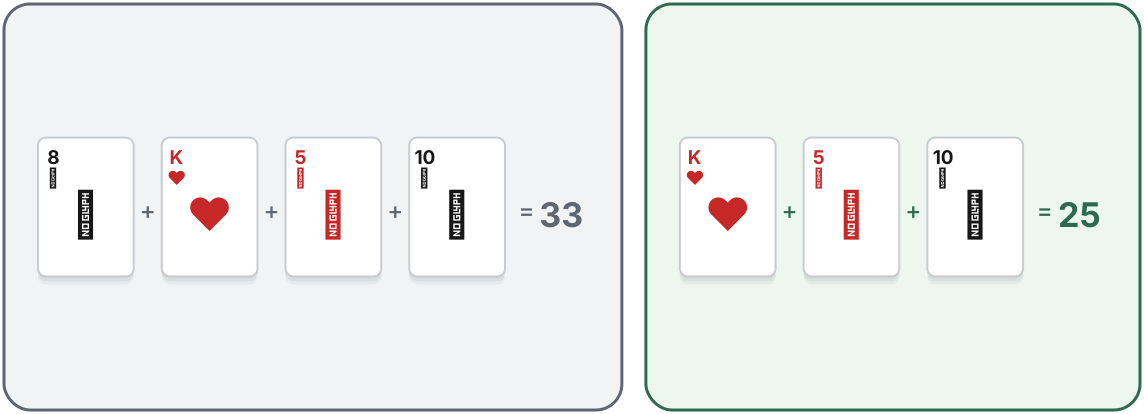
An example: you knock with ♠️7 ♥️7 ♦️7, ♣️9 ♣️10 ♣️J and ♥️3 ♥️4 ♥️5 on the table and ♦️8 as deadwood, which is 8 points. Your opponent spreads ♠️2 ♠️3 ♠️4 and ♦️Q ♥️Q ♣️Q, holding ♣️8 ♥️K ♦️5 ♠️10, worth 33. But ♣️8 fits the bottom end of your club run, so off it goes and their count drops to 25. You score 17, the difference between 25 and 8.
It can turn the other way. You knock on 9 points, your opponent has 12 and lays off two cards worth 5 between them. The counts now read 9 against 7, so the opponent takes 2 points for the difference plus the 10 point bonus, 12 in all.
If the stock is down to two cards with nobody having knocked, the round is dead. The player who took the third last card discards as normal, and unless that discard is a knock, neither of you scores. The same dealer deals again.
Rounds keep coming until one of you reaches 100 points or more. The game ends there, and the winner takes a 100 point bonus. On top of that, both players add 20 points for every round they won. That one is known as the box or line bonus, and it only counts towards the final total, never towards the race to 100. If the loser failed to win a single round, the winner's bonus is 200 points instead of 100.
About this version
These rules describe Gin Rummy for two players: 52 cards without jokers, ten cards each, knocking at 10 points of deadwood or less, and play to 100 points. The bonuses are 20 points for gin, 10 for an undercut and 20 for each round won, the numbers the older rule books use. A great many players now use 25 for all three, and some Norwegian rule sets use 40, 20 and 30. Both alternatives are listed under variants.
Do you play with different rules where you live, or did you spot a mistake? Send me an email.
Similar games
500 Rummy (alias 500, Rummy 500, 500 Rum or Pinochle Rummy)
Lay down groups and sequences, dig into the discard pile for the card you need, and pass 500 points first.
Stress (alias James Bond or Atlantis)
Swap cards with the four in the middle until every pile holds four of a kind, then shout Stress before anyone else.
Remi (alias Liverpool Rummy or Contract Rummy)
Seven rounds, each with its own contract of sets and runs. Buy the cards others throw away and keep your score low.