Klondike Solitaire Rules
Klondike is a solitaire game for 1 player. A game typically takes 5-15 minutes, and the recommended age is 8+.
Rules for the solitaire Klondike: The world's most widely known solitaire. Move all 52 cards to foundations, sorted by suit from Ace to King. Klondike is also known as Solitaire, Patience, Canfield or Windows Solitaire.
Klondike was historically called Canfield in America, and that is the name it reached England under. Modern solitaire collections use Canfield for a different game, also known as Demon, which these rules do not describe.
About the Game
Klondike, also known as Patience or simply Solitaire, is the most widely played solitaire in the world. Where the name comes from, nobody actually knows: several writers have guessed at the Klondike Gold Rush of the 1890s, but no evidence backs it up. The earliest known rules appeared in the 1907 edition of Hoyle's Games as Seven-Card Klondike.
Hundreds of millions of people met the game through Microsoft Windows, which has shipped it since Windows 3.0 in 1990, partly as a pastime and partly to teach new users the mouse. The goal is to move all 52 cards onto four foundation piles, each built by suit from ace to king. Winning takes patience, planning and luck in roughly equal measure.
What You Need
A standard 52-card deck. The jokers stay in the box.
Beyond that, a table with room for seven columns side by side, plus space above them for the stock and the four foundations. Pen and paper only come out if you want to keep score the way the Windows version does.
Game Setup
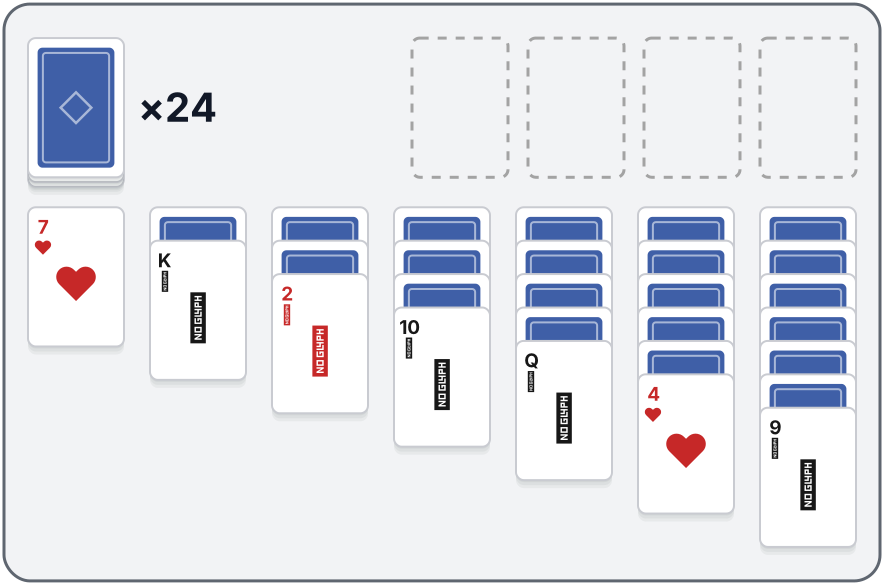
Deal seven columns onto the table, together called the tableau:
- Column 1: One card (face up)
- Column 2: Two cards (one down, one up)
- Column 3: Three cards (two down, one up)
- Column 4: Four cards (three down, one up)
- Column 5: Five cards (four down, one up)
- Column 6: Six cards (five down, one up)
- Column 7: Seven cards (six down, one up)
That uses 28 cards. The remaining 24 form the stock, placed face down, and four empty spaces in the upper right are reserved for the foundations.
Game Rules
The moves available to you:
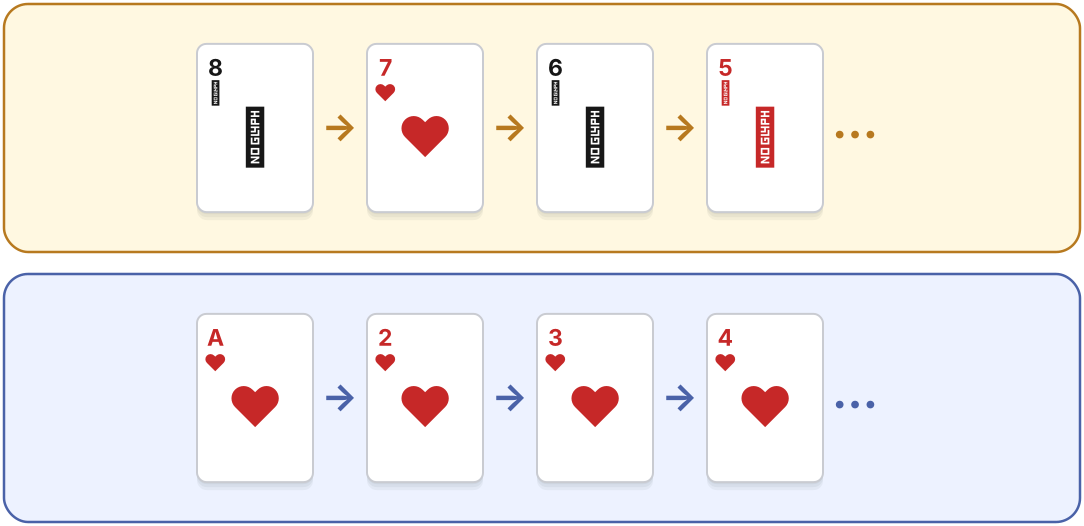
- In the tableau, build downward in rank with the colors alternating between red and black. A red 6 goes on a black 7
- Sequences move as a unit, and you may also pick up just the lower part of one, as long as the card you move fits its destination
- An empty column takes only a king, or a sequence led by a king
- Whenever the top card of a column moves away, turn the card beneath it face up
- The foundations build upward by suit, ace through king
- A card already on a foundation may come back down to the tableau if you need it there
Drawing from the Stock
When the tableau offers nothing, the stock does. The two usual ways to draw:
- Turn three: flip three cards at once onto a waste pile, with only the top one playable. This is the standard way, and the harder one
- Turn one: flip a single card at a time. Easier, and you will finish far more games
Anything you cannot use stays on the waste pile, whose top card is always available. Once the stock runs dry, turn the waste over and go through it again. The common rule puts no limit on how many passes you take. Stricter options are listed under Variations.
Scoring
If you want to keep score, the Windows system is the one most people use:
- Waste to foundation: 10 points
- Tableau to foundation: 10 points
- Waste to tableau: 5 points
- Turning a tableau card face up: 5 points
- Foundation back to tableau: -15 points
- Turning the waste over in turn-one play: -100 points
A card that travels from the waste through the tableau and onto a foundation collects 15 points, against 10 for playing it straight up.
The alternative is Vegas scoring: you pay $52 for the deal and earn $5 per card placed on the foundations, with a single pass through the stock.
Winning the Game
You win when all 52 cards sit on the four foundations, each showing its suit from ace to king.
You lose when no legal move remains and one more pass through the stock turns up nothing useful. Some deals simply cannot be solved, so a lost game is not proof of a mistake.
About this version
These rules describe standard Klondike: 52 cards, seven tableau columns built downward in alternating colors, and foundations built up by suit from ace to king. Turn-three drawing with unlimited passes is the baseline, while turn-one drawing, limited passes and Vegas appear as variations.
Do you play with different rules where you live, or did you spot a mistake? Send me an email.
Similar games
Pyramid Solitaire (alias Pyramid, Pile of Twenty-Eight or Tower of Twenty-Eight)
Pair up cards that add to 13 and take the pyramid apart. Kings need no partner at all.
FreeCell (alias Kungen or Admirális)
A skill-based solitaire where every card is visible from the start. 99% of deals are winnable.
Gaps (alias Montana, Addiction or Spaces)
Arrange all cards in ascending order by moving them through empty spaces, but be careful not to block yourself.