TriPeaks Solitaire Rules
TriPeaks is a solitaire game for 1 player. A game typically takes 5-10 minutes, and the recommended age is 6+.
Rules for the solitaire TriPeaks: Tear down three peaks of hidden cards by chaining one rank up or down from the waste pile before the stock runs out. TriPeaks is also known as Three Peaks, Tri Towers or Triple Peaks.
About the game
TriPeaks is a solitaire where three peaks of cards are torn down one card at a time, each played to the waste pile one rank above or below whatever sits on top of it. Most of the board starts face down: only the bottom row shows, and every card you remove can turn up new ones.
Robert Hogue designed the game in 1989, and it shipped with a Windows game pack the year after. It has since become one of the most played solitaires anywhere, though it never needed a screen. One ordinary deck does the job.
A deal takes five to ten minutes.
What you need
A standard 52-card deck with the jokers removed.
Table space for three small pyramids side by side, with the stock and waste pile below them. The layout is wide, about the footprint of a big board game.
No pen, no paper. The game is simply won or lost.
Dealing and setup
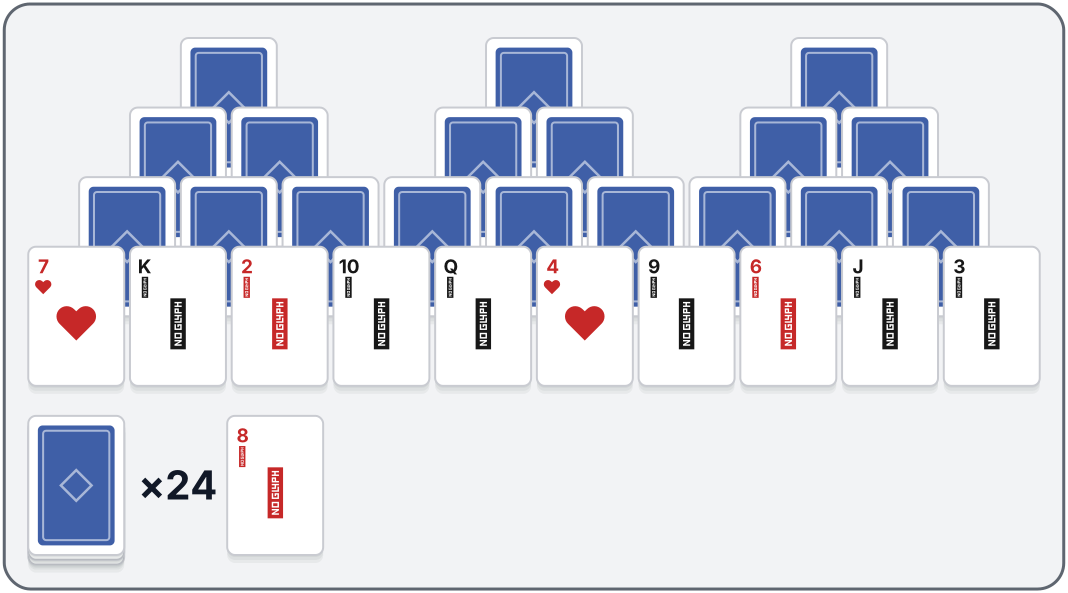
Start with three cards face down, spaced well apart. Each is the top of a peak.
Cover each of them partly with two face-down cards a little lower on the table, then deal a row of nine face down the same way, three below each peak. Each new row overlaps the bottom edge of the row above, leaving every hidden card pinned by two cards in the row below it.
Finish with a single row of ten cards face up along the bottom, partly covering the row of nine. This row runs under all three peaks and ties them together. The tableau now holds 28 cards: 18 hidden and 10 showing.
The 24 cards left over go face down as the stock. Turn the top one up beside it to open the waste pile.
Playing to the waste pile
A card is open when nothing lies on top of it. At the start that means the ten cards of the bottom row. Any open card may go to the waste pile if it is one rank above or one rank below the card showing there, and suits never matter. With ♦️8 on the waste pile, any 7 or any 9 can follow.
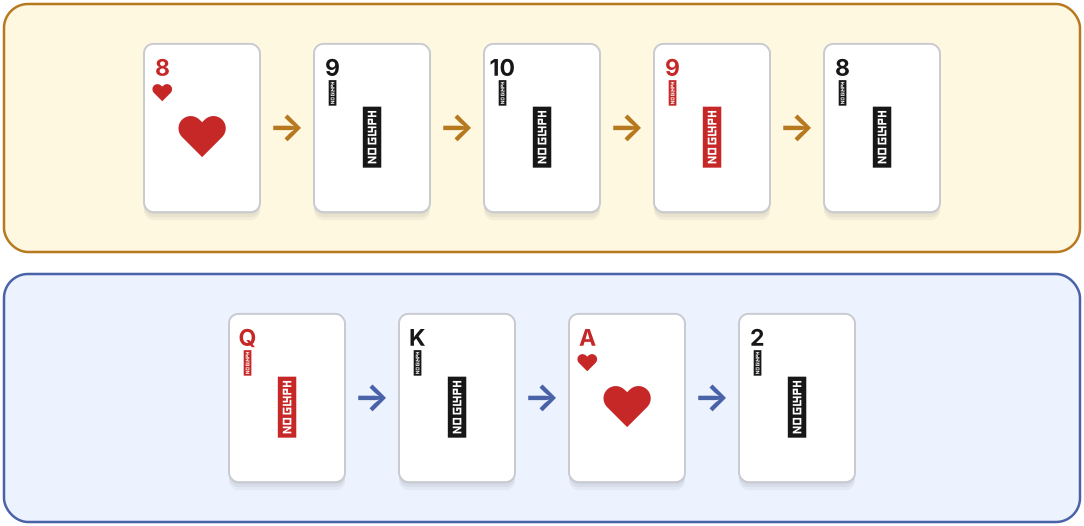
Each card you play sets a new target, which is how chains grow. The direction is free to change at every step, so 8, 9, 10, 9, 8 is a perfectly legal run.
The sequence turns the corner: an ace goes on a king and a king on an ace, so queen, king, ace and two all connect. No card is a dead end.
Cards never move between the peaks and never come back from the waste pile. Playing an open card onto the waste pile is the only move in the game.
Turning up the hidden cards
A face-down card is turned up the moment nothing covers it, and from then on it is open like any other card.
Every hidden card is pinned by two cards in the row below it. Take away two neighbouring cards in the bottom row and the card they were pinning in the row above turns up. That is how you eat your way up the board, row by row.
The peak cards sit deepest of all: each one only turns up once the whole pyramid beneath it is gone, so the three peaks are always the last cards to fall.
The stock
When no open card fits the waste pile, flip the top card of the stock onto it and start a fresh chain from there.
You may flip from the stock whenever you like, legal moves or not, but every flip is a chance spent. The stock holds 24 cards, it is never dealt again, and the waste pile cannot be dug through.
Stock cards are only starting points. They are not part of the board and never count against you: the game is about the 28 tableau cards alone.
Winning and losing
The game is won when all three peaks are cleared, meaning every one of the 28 tableau cards has reached the waste pile. Winning on the very last stock card still counts, and leftover stock cards cost nothing.
If the stock is empty and no open card fits, the game is lost. Gather up, shuffle, and deal again.
For something to measure, count the cards left on the board and try to beat that number next deal. A zero is a win.
About this version
These rules describe the original 1989 game: 28 cards in three peaks sharing a bottom row of ten face-up cards, a 24-card stock with a single pass, and the sequence turning the corner between king and ace. The base game is played without scoring. Digital point scoring and the layout with three separate pyramids are covered under variants and house rules.
Do you play with different rules where you live, or did you spot a mistake? Send me an email.
Similar games
Clock Patience (alias Clock Solitaire, Sundial or Travellers)
Deal cards in a clock shape and try to turn all 52 cards before the fourth King appears.
FreeCell (alias Kungen or Admirális)
A skill-based solitaire where every card is visible from the start. 99% of deals are winnable.
Spider Solitaire (alias Spider)
Build eight sequences from King to Ace. Solitaire with three difficulty levels.