Klaberjass Card Game Rules
Klaberjass is a card game for 2 players. A game typically takes 30-45 minutes, and the recommended age is 12+.
Rules for the card game Klaberjass: A game for two with 32 cards. Name trumps, score for runs and bela, and lose it all if you fail. Klaberjass is also known as Clobyosh, Klabberjass, Klob, Kalabrias or Bela.
About the game
Klaberjass is a two-player trick-taking game played with 32 cards. Points come from two places at once: the cards you capture in tricks, and the runs you hold in your hand before a single card is played. The first player to 501 wins.
One of you commits to the hand by naming trumps, and that promise is the whole tension of the game. Take on a hand and fail to outscore your opponent, and every point you made goes across the table instead.
The game answers to a lot of names. English speakers usually call it Clobyosh, Klob or Kalabrias, Scottish mining villages call it Bela, and all of them go back to the Dutch Klaverjas. The earliest known description is in a Dutch book from 1821. Its close relative is Belote, the French four-player game in the same family.
What you need
A 32-card pack: strip out everything from 2 to 6 and the jokers, leaving ace, king, queen, jack, 10, 9, 8 and 7 in each suit. Packs sold for Piquet, Belote or Skat are already the right size.
Pen and paper too. A game runs over several hands and the totals climb past 500, so nobody keeps score in their head.
Card values
Every card carries a point value, and that value also decides which card wins a trick. Highest value takes it. Two cards behave completely differently once their suit is trumps.
| Card | Plain suit | Trumps |
| Jack | 2 | 20 |
| 9 | 0 | 14 |
| Ace | 11 | 11 |
| 10 | 10 | 10 |
| King | 4 | 4 |
| Queen | 3 | 3 |
| 8 | 0 | 0 |
| 7 | 0 | 0 |
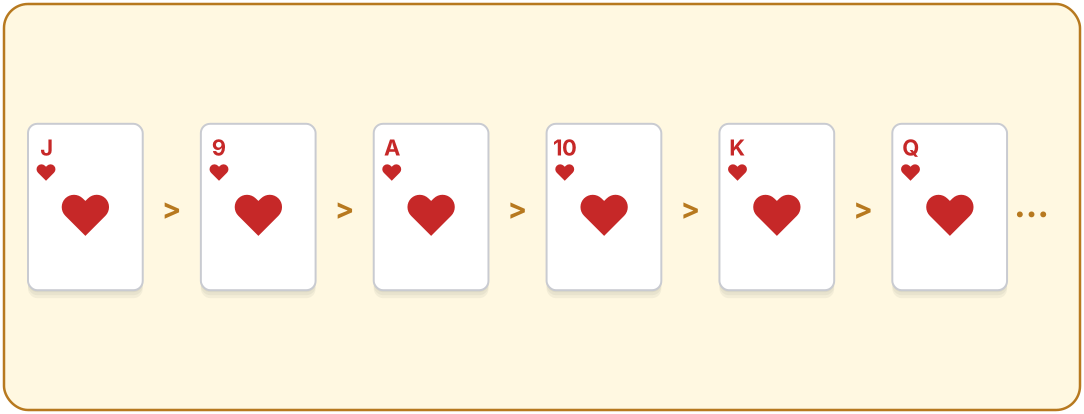
So a plain suit runs ace, 10, king, queen, jack, 9, 8, 7, while trumps run jack, 9, ace, 10, king, queen, 8, 7. The trump jack is the yuss and the trump nine the manel. Together they are worth 34 points, which is why a hand holding both is worth taking on.
Any trump beats any card in another suit. The trump 7 takes the ace of hearts, and there is an old proverb among Clobyosh players to that effect.
A hand contains 152 card points, plus 10 for the last trick.
The deal
Cut for first deal, high card deals. After that the winner of the previous hand deals, which evens things out, because the non-dealer has a real edge.
The dealer gives three cards to the opponent, three to himself, then another three each. Both of you now hold six cards. The next card off the pack is turned face up on the table and the remaining 19 are laid part-way across it. That face-up card proposes a trump suit.
Once trumps are settled, the dealer gives three more cards to each player, bringing both hands to nine. Thirteen cards are left over. Take the bottom one, turn it face up and put it on top of the stack. It stays out of the hand and simply tells you both about one card neither of you can be holding.
Choosing trumps
With six cards each you decide what trumps will be. The non-dealer speaks first.
- Accept the suit of the turned-up card by saying "I take", and you are the taker.
- Pass, and the dealer gets the same choice.
- If the dealer passes too, the non-dealer may name a different suit, but not the suit that was turned up.
- If neither of you wants that either, the cards go back in and the non-dealer deals the next hand.
Saying "I take" is a promise to finish the hand with more points than your opponent. You are making it on six of your eventual nine cards, so those last three can turn a promising hand into a certainty or leave you exposed.
When the turned-up suit becomes trumps, whoever holds the trump 7 may swap it for that face-up card. No swap is allowed if a different suit was named.
Runs and bela
Three or more cards in sequence in one suit are worth points. Sequences use the plain order ace, king, queen, jack, 10, 9, 8, 7, never the trump order. ♠️A-♠️K-♠️Q-♠️J is a fifty. ♠️A-♠️10-♠️K-♠️Q is not a sequence at all.
- Four cards in sequence: 50 points
- Three cards in sequence: 20 points
- King and queen of trumps, called bela: 20 points
Only one player scores for sequences, and it is whoever holds the best one. That player then scores every sequence in their hand and the other scores none. A fifty beats a twenty. Between two of the same length, the higher top card wins, then a sequence in trumps, and last the one declared first.
You declare during the first trick without naming the suit. Say "I have a fifty" or "I have a twenty", and your opponent answers "good" if he cannot beat it. If you both hold the same length, you name your top card, and only if those tie do you name the suit. The winning sequence is laid out during the second trick, and that is also when you show any extra sequence you were sitting on.
Two conditions catch beginners. A sequence scores nothing until you have won at least one trick, and sequences cannot overlap: ♠️A-♠️K-♠️Q-♠️J-♠️10-♠️9 is worth 50, not 70.
Bela works differently. You announce it as you play it, saying "bela" on the first of the two cards and "from the bela" on the second. It always scores, whoever won the sequence contest.
Playing the tricks
The non-dealer leads the first trick, and the winner of each trick leads the next. Nine tricks, and the rules about what you may legally play are tighter than in most trick games.
- Follow the suit led if you can.
- If you cannot follow, you must play a trump.
- If a trump was led, you must play a higher trump if you hold one.
- Only when you can neither follow nor trump are you free to discard.
Being forced to trump is what makes the game hard. A short suit is not only a chance to win tricks, it is also an obligation that burns your trumps in an order you did not pick.
Say hearts are trumps and your opponent leads ♠️A. With no spades left you must trump, even if all you have is ♥️7 and you were saving it. Hold ♠️8 and that goes instead, and your trump survives.
Whoever wins the last trick scores 10 points, no matter what card did it, so keeping a certain winner back for the end is usually worth a little planning.
Scoring
With all nine tricks played, the player who did not name trumps counts first. Those points always stand. Add up sequences, bela, 10 for the last trick if you won it, and the value of every card in your tricks.
The taker then counts the same way, but that total only stands if it beats the opponent's.
If it does not, the taker is bate, from the French bête, and the whole hand goes the other way. A taker on 71 against 91 hands over all 162 points. That is what a bold "I take" risks.
Equal totals leave the points in limbo. Whoever wins the next hand collects them on top of their own, and the deal simply alternates, since nobody won.
First to 501 takes the game. You may claim mid-hand as soon as your tricks, sequences and bela add up, but only after winning a trick and before you lead to the next one. Claim without the points and you lose the game there and then. Sit on 506 without saying anything and an opponent who reaches 501 and claims it first wins instead.
About this version
These rules describe two-player Klaberjass as documented under the names Clobyosh and Bela: 32 cards, nine-card hands, trumps settled in two rounds of bidding, and play to 501 points. Sequences score 50 and 20, bela scores 20 and the last trick 10. Schmeiss, the 500-point target and the three and four-player versions are covered under variants.
Do you play with different rules where you live, or did you spot a mistake? Send me an email.
Similar games
Piquet (alias Rubicon Piquet, Sant or Saunt)
A classic for two with 32 cards. Trade with the talon, declare point, sequence and set, then take the tricks.
Belote (alias Belotte or Coinche)
France's national card game. Strategic team play with tricks and combinations for 4 players.
500 Rummy (alias 500, Rummy 500, 500 Rum or Pinochle Rummy)
Lay down groups and sequences, dig into the discard pile for the card you need, and pass 500 points first.